Why a tunnel can fool your sense of speed
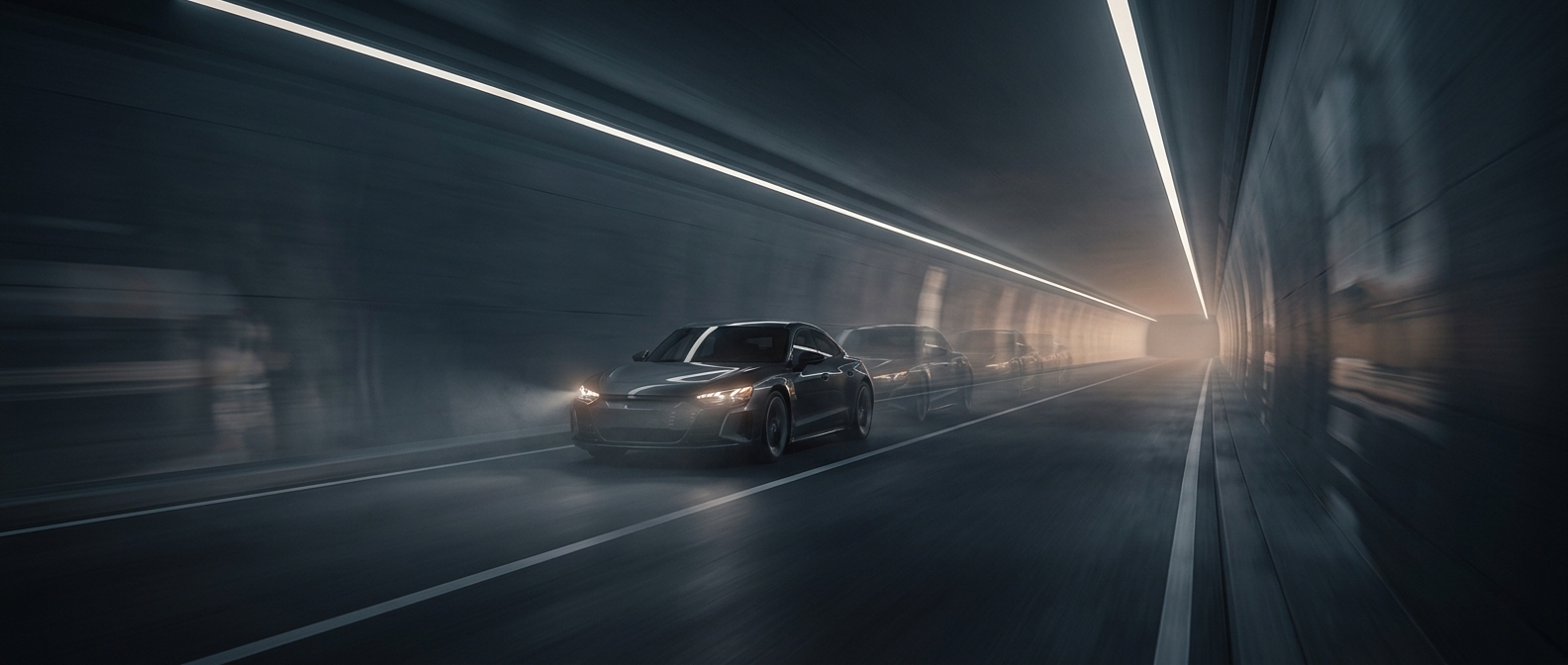
On an open road, drivers judge motion using several cues at once: lane markings sliding beneath the car, roadside objects passing at different rates, and the changing distance to trees, buildings, or the horizon. A tunnel removes many of those references. Its close, repetitive walls fill the view, while the far end may offer little useful sense of distance.
The brain estimates movement partly from optic flow—the pattern of images shifting across the eyes as you travel. In a tunnel, nearby surfaces stream past quickly, but their uniformity makes it harder to compare one moment with the next. Without a varied landscape to anchor the estimate, the driver’s sense of speed can drift. Some drivers may press the accelerator without consciously deciding to go faster.
How wall patterns can help
A tunnel need not be visually blank. Repeated markings or changes in the wall surface give the eyes distinct features to track. Those features can make the movement of the scene easier to read, interrupting the long, monotonous sweep of the walls. The aim is not decoration: it is to provide visual information where the surrounding landscape can no longer do the job.
That is a subtle engineering challenge. Markings must be noticeable enough to offer a reference, but not so distracting that they compete with signs, traffic, or the road ahead. A small change in the tunnel’s visual rhythm can help restore a cue drivers normally get for free from the world outside.