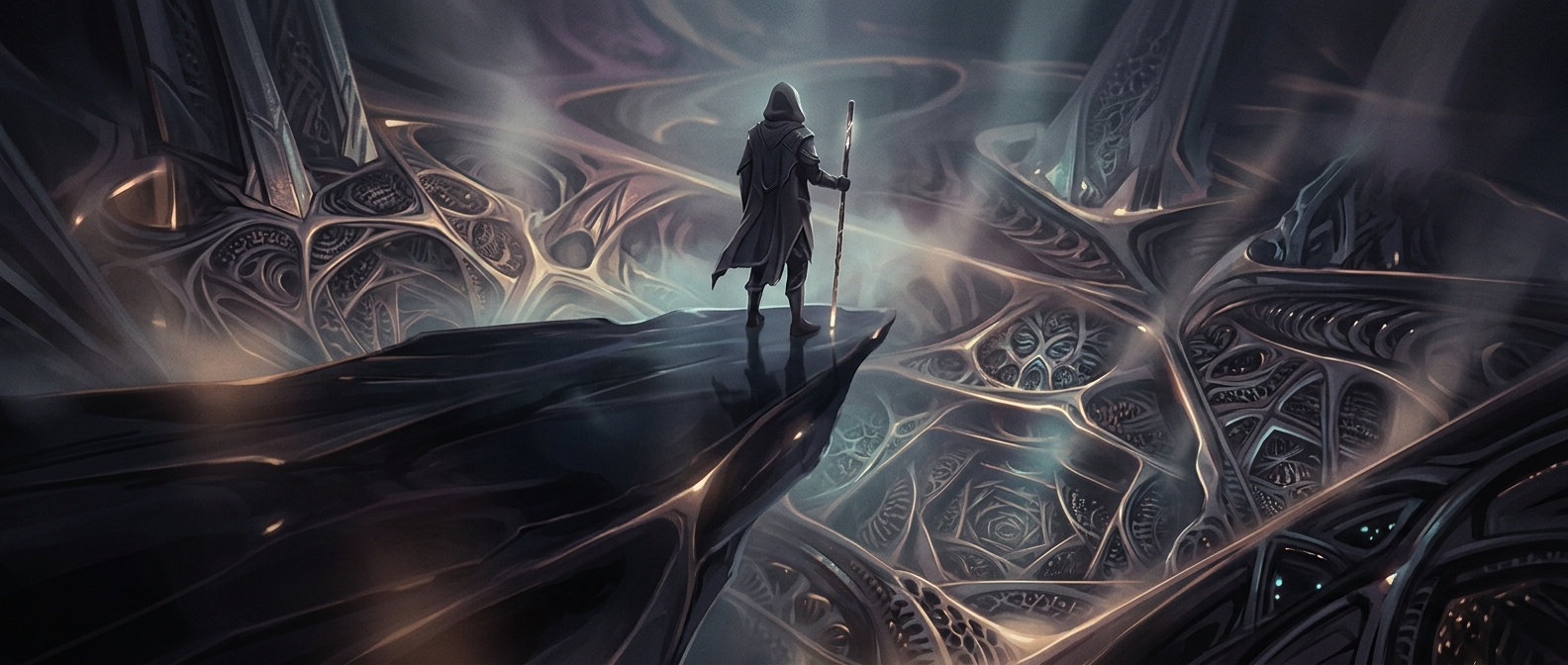
How one rule creates a fractal’s detail
A fractal is a shape whose structure keeps revealing patterns at smaller scales. The trick is recursion: apply a rule to the result of the previous step, then repeat. In the classic Koch snowflake construction, for example, each straight segment is replaced by four shorter segments that form a tiny triangular bump. Repeat that replacement, and every new edge sprouts more edges.
The rule itself can be simple; the complexity comes from applying it many times. Some fractals repeat the same motif exactly, while others show only a looser resemblance between large and small parts. Either way, a pattern that looks intricate can arise without separately designing every bend and branch.
What “endless” means on a screen
In mathematics, the rule can be repeated without a final step. A computer, however, performs a chosen number of iterations. For a fractal such as the Mandelbrot set, it tests each point by repeatedly updating a number according to a formula. The point’s behavior determines whether it belongs to the set; a visualization can use how quickly it escapes to assign a color.
More iterations can reveal finer structure, but they also require more calculation. Zooming in does not mean the computer has drawn an infinite picture—it is calculating another finite view from the same rule. The remarkable part is that the detail is generated by repetition, not stored as a vast collection of individually specified shapes.