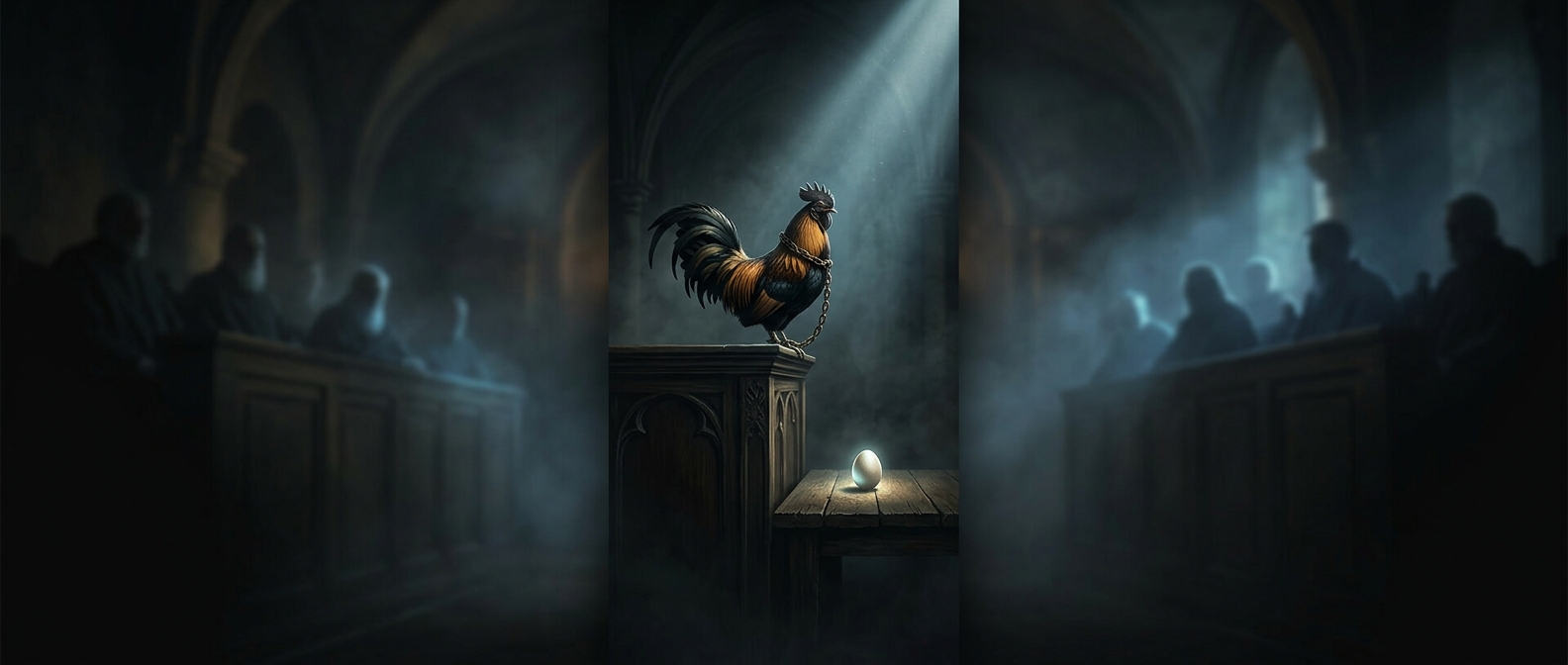
Why a rooster’s egg could become a court case
In medieval Europe, unusual events were not always treated as mere accidents. A supposed egg laid by a rooster could be read as a violation of the natural order—and, in a religious worldview, as a sign of dangerous or demonic influence. The charge in Basel was therefore not simply that an animal had done something odd. It cast the event as a threat that required a public response.
The case belongs to a wider practice known as animal trials: formal proceedings in which animals were accused of crimes and subjected to legal punishment. Such cases show how far premodern courts could extend human ideas of guilt and justice beyond human defendants. The trial made the accusation legible in familiar terms: there was an alleged offender, a charge, and a sentence.
A sentence aimed at more than the animal
Burning the rooster was a way to stage the rejection of what people understood as an unnatural act. Public punishment could reassure a community that a disturbing event had been identified and dealt with. It also reveals a different boundary between nature and law: the court treated an animal’s supposed behavior not as biology to investigate, but as conduct with moral and religious meaning.
That is what makes the episode more than an eccentric footnote. In Basel, an extraordinary claim about an egg was translated into the language of a human courtroom—and answered with a human sentence.