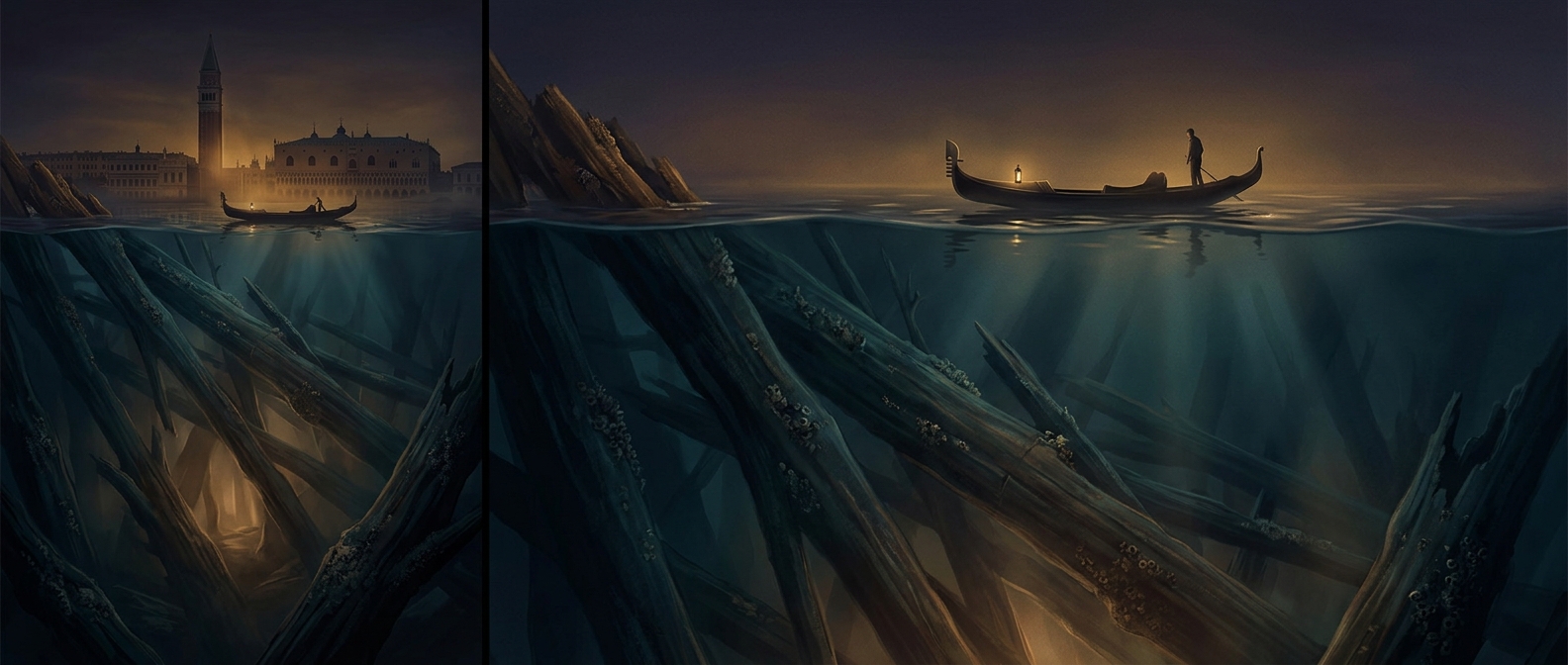
A foundation built below the waterline
Venice’s buildings stand on a layered foundation system, not on a single mass of wood. Builders drove thousands of timber piles through soft lagoon mud, then laid wooden platforms and stonework above them. Packed closely together, the piles helped spread a building’s weight into more stable layers beneath the mud.
The setting that threatened ordinary wooden structures also helped preserve these supports. Buried and continually waterlogged, the timber had little exposure to oxygen. That made it harder for the fungi and other organisms that cause wood to decay to do their work.
How wood came to seem like stone
Over long periods, mineral-bearing water moved through the submerged timber. Minerals accumulated in the wood, helping it become harder and denser. This process is sometimes described as the wood “turning to stone,” but the piles did not become solid rock: they remained timber, altered and reinforced by mineral deposits.
The important combination was protection from rapid decay and a foundation layout that distributed heavy loads. Neither the wood nor the mud had to behave like modern concrete; the whole system worked because the piles, platforms, and ground supported one another.
The hidden structure beneath the city
Much of Venice’s support is out of sight, buried below streets and buildings. The visible stone architecture rests on a foundation shaped by the lagoon’s particular conditions: saturated ground, limited oxygen below the surface, and centuries for minerals to accumulate in the wood. What looks like a city rising directly from water is, beneath the waterline, a carefully layered structure anchored in mud.