What “60 hertz” means for household electricity
In North American power systems, alternating current (AC) does not travel steadily in one direction. The voltage rises and falls, then reverses, producing a repeating electrical wave. At 60 hertz, that pattern repeats 60 times each second. Each repeat is one cycle, and the current changes direction twice during it.
The electrons in a wire therefore shift back and forth rather than streaming continuously from a power plant to an appliance. Their motion is small; the electrical energy is transmitted through the circuit and delivered to the device.
Why the frequency matters
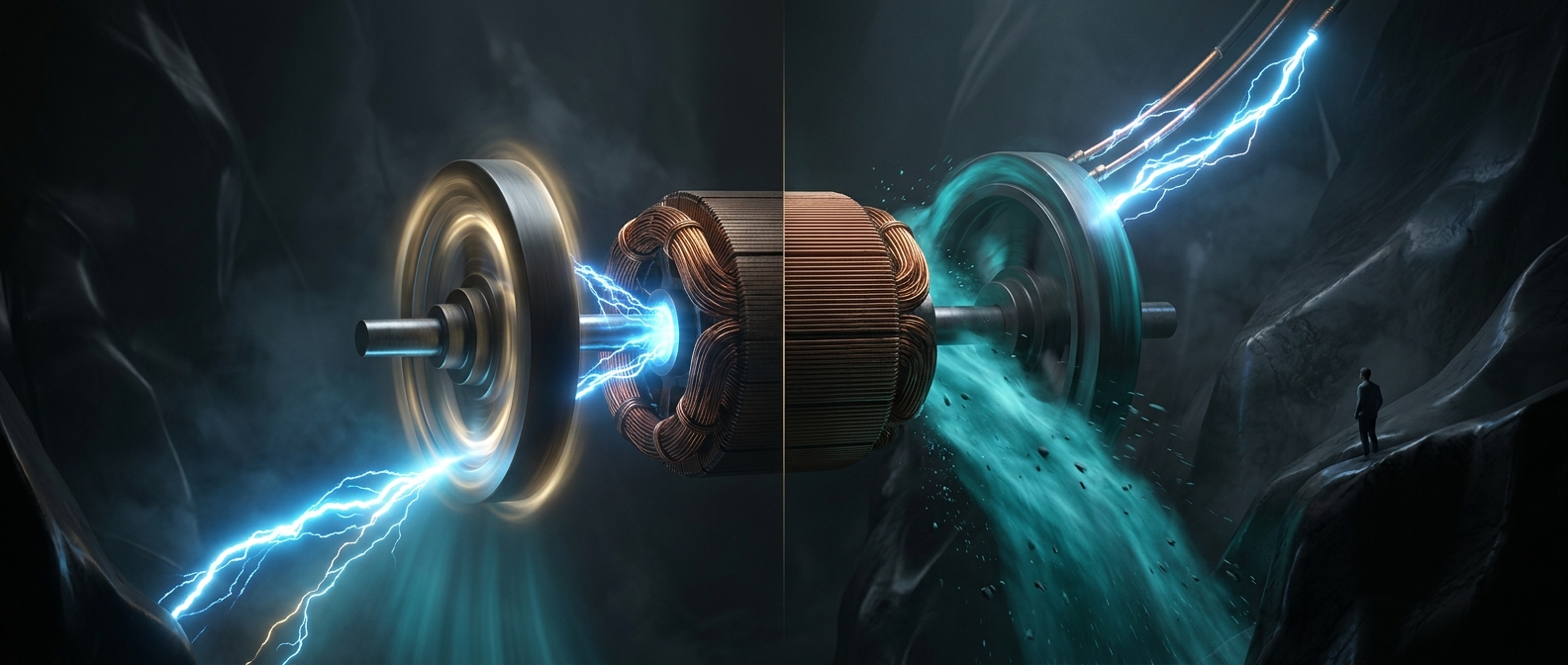
The 60-cycle rhythm comes from how utility generators produce electricity. In a generator, rotating magnets or coils create voltage that repeatedly changes polarity. The rotation rate and the generator’s design determine the frequency. Power plants and grid operators keep the interconnected system close to its target frequency because generators, motors, and clocks that depend on the electrical rhythm are designed around it.
For example, an AC motor can use the changing direction of current to create a rotating magnetic field. That field turns the motor’s rotor, so the grid’s frequency helps determine how quickly the motor runs. A device’s electronics may instead convert AC into the steady, one-way current its circuits need.
The pendulum comparison—and its limit
A pendulum completes one full cycle when it swings out and returns to its starting point. It passes through the middle twice on that trip. Likewise, AC completes 60 full cycles per second and reverses direction 120 times. The comparison captures the repeated reversal, though electricity is a changing electromagnetic effect in a circuit, not a stream of charged particles swinging from one end of a wire to the other.