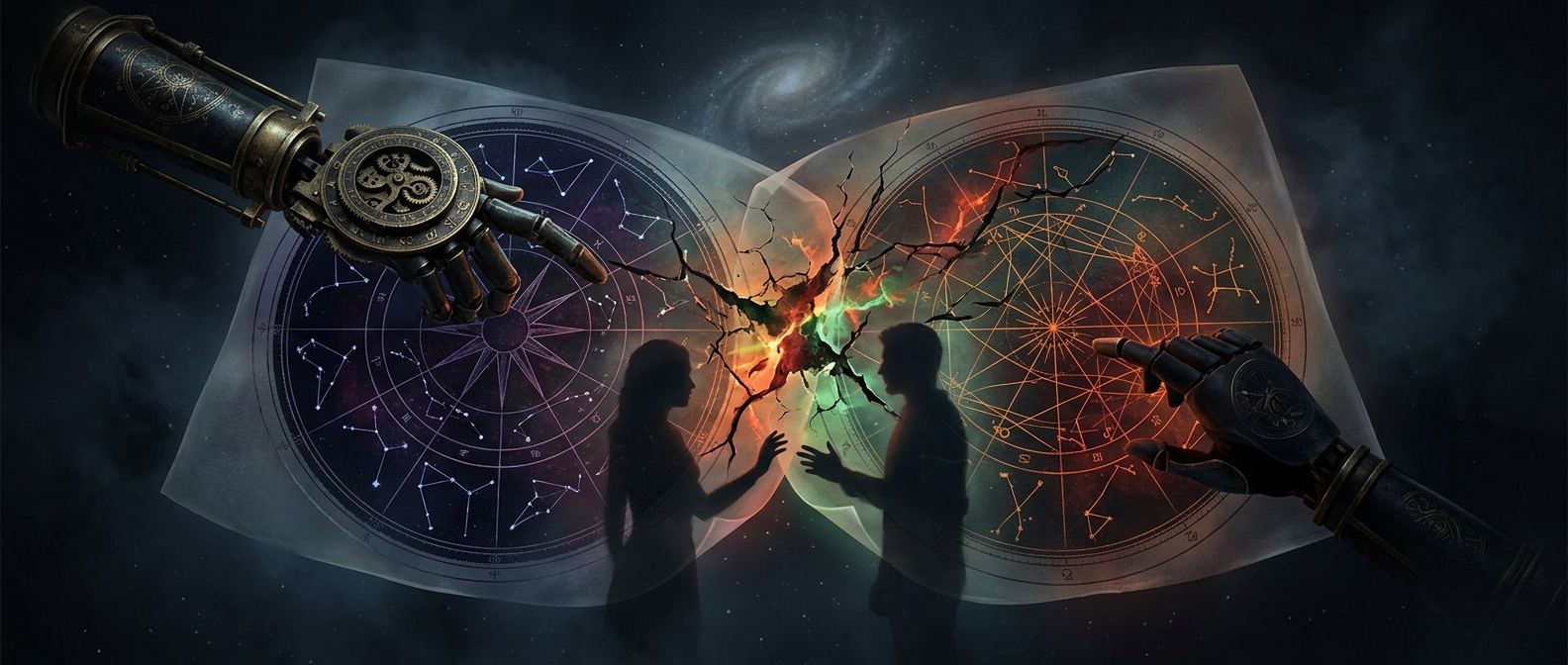
How astrologers build a composite chart
In relationship astrology, a composite chart is made by combining two people’s birth charts into a single chart. Rather than placing both charts side by side, an astrologer calculates a midpoint between corresponding planetary positions. The result is a new set of placements assigned to the relationship itself.
For example, if one person’s Sun is at one point in the zodiac and the other person’s Sun is elsewhere, the composite Sun is placed halfway between them along the zodiac. The same midpoint method is used for other chart points. Because the zodiac is a circle, the calculation must account for positions near its boundary: halfway between late Pisces and early Aries is near the boundary, not on the opposite side of the zodiac.
What the “third entity” means
Within the astrological framework, the composite chart is read as a symbolic portrait of the partnership: its shared character, recurring themes, and possible trajectory. It is not a third person or a chart for a literal birth. The “third entity” is a way of treating the relationship as something with patterns that cannot be reduced to either partner’s individual chart.
That changes the questions an astrologer asks. Instead of focusing only on what one person wants or how the other behaves, they may interpret the composite chart’s placements as describing the tone and pressures of the bond between them. The chart is therefore a separate interpretive layer, not a replacement for either person’s birth chart.
The practical consequence is a shift in viewpoint: the relationship becomes the subject being examined. In this tradition, its chart can be discussed as having its own trajectory—even though it is constructed from the two people’s charts rather than from a separate birth.