How China’s High-Speed Rail Became a Country-Spanning Network
China’s high-speed rail is not just a collection of fast routes between a few famous cities. Its lines form a large, interconnected system linking regional centers across the country. That scale changes what a long-distance journey can feel like: instead of treating each province as a separate leg, a passenger can stay aboard as the train crosses several of them.
The engineering behind a steady ride
Many high-speed lines use slab track: rails fixed to a continuous concrete base rather than laid on loose gravel. The stable surface helps keep the rails aligned under repeated traffic, while careful track construction limits jolts and vibration. The train’s smoothness is not simply a matter of speed; it depends on the track, the train, and the precision with which they work together.
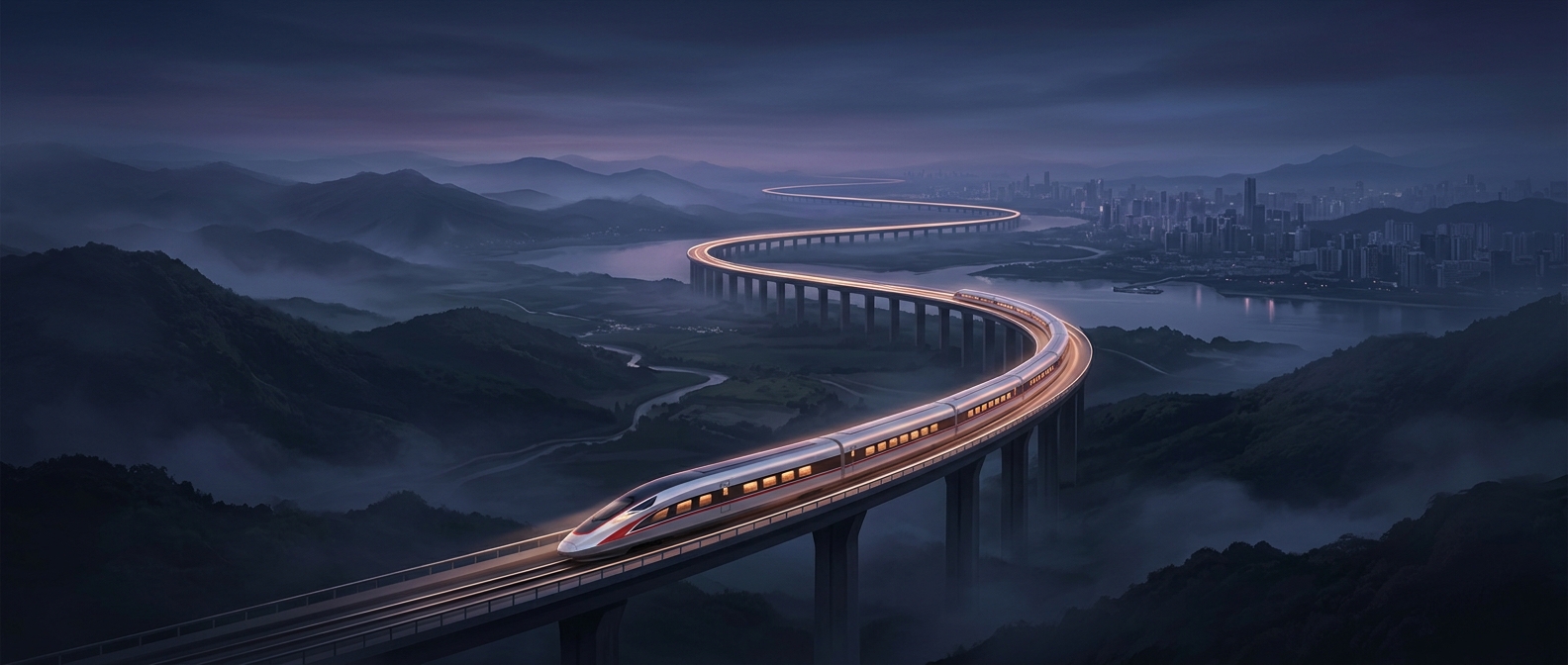
To keep routes direct through varied terrain, engineers use bridges and tunnels to cross rivers, valleys, and hills. These structures can make a line more expensive to build, but they avoid some of the sharp curves and steep gradients that would slow trains or make the ride less even.
What the network means for a trip
A train that crosses several provinces makes the country’s scale tangible. Landscapes and built-up areas change outside the window, while the journey remains continuous. The network’s reach also depends on stations and connections: high-speed rail is most useful when passengers can get from the platforms to the cities and onward to other routes.
That combination—long corridors, smoother track, and links between regions—is what makes a brief ride feel like a passage across a much larger map.