Why the Foam Needs a Moment
A stout’s creamy head is shaped by a difference between the gas in the beer and the way it is served. Carbon dioxide dissolves readily in liquid, where it gives many beers their sharp, fizzy bite. Nitrogen is less soluble, so it escapes more readily when the beer’s pressure drops as it enters the glass.
That release creates a rush of tiny bubbles. In a pint glass, the flow can make bubbles appear to move downward through the dark beer even as the beer is being poured—a visual churn known as the cascade. The motion is temporary: as the turbulence fades, bubbles rise and gather at the surface.
A Pour in Two Stages
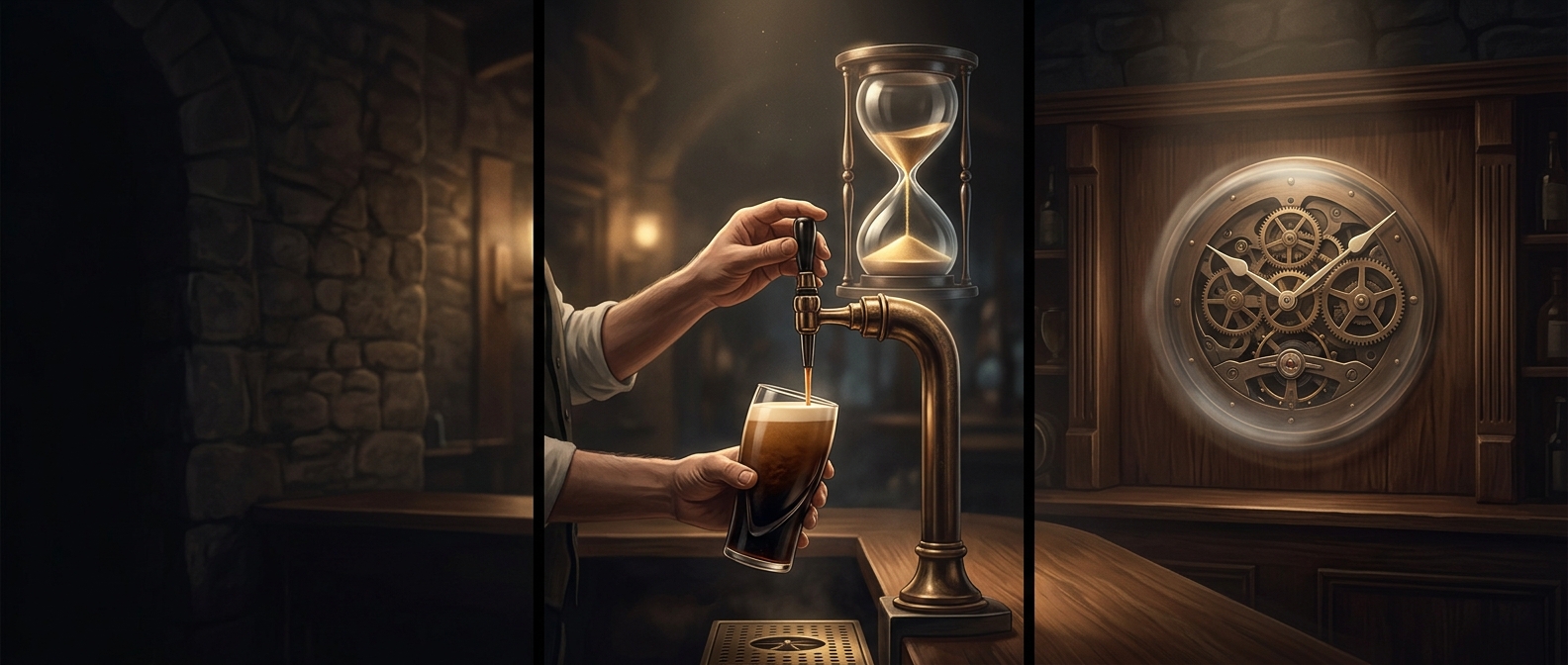
The bartender first fills the glass partway, then pauses. That break is practical: it lets the moving beer settle and the foam gather into a stable layer, leaving room to top up without pushing the head over the rim. The second pour completes the glass while preserving a clean boundary between the dark body and pale cap.
A dense head also changes how the stout feels and tastes. Its closely packed bubbles create a soft, velvety texture, while the foam carries aromas to the nose with each sip. The pause is part of controlling the beer’s structure, not simply waiting for the glass to look finished. The finished pint is the visible result of gas, pressure, and pouring flow settling into balance.