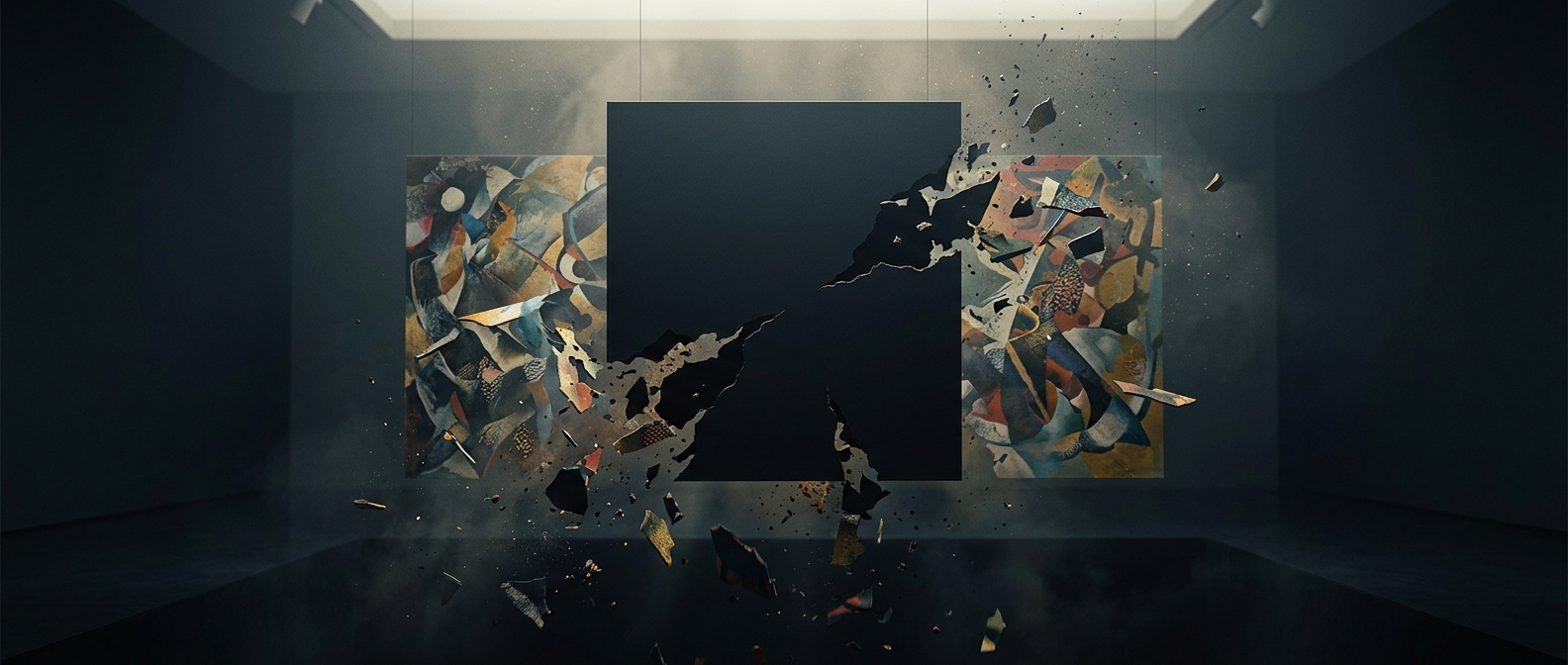
A painting with no subject to recognize
Kazimir Malevich’s Black Square, first shown in 1915, offered viewers almost nothing familiar to identify: a dark, roughly square shape against a light ground. In an era when paintings were commonly judged by what they depicted—people, places, or stories—the absence of a scene was itself a radical decision. The work made the viewer confront the paint, shape, and contrast rather than search for a hidden narrative.
Malevich called the new approach Suprematism: an art movement built from simple geometric forms and intended to give color and shape a central role, independent of recognizable objects. A square could matter as a visual presence, not as a symbol that had to stand for something else. That shift challenged a basic expectation about what a painting was supposed to do.
Why the simplicity was difficult to accept
The work’s plain appearance concealed a demanding claim. If a painting no longer needed to portray the world, then skill and meaning could not be measured only by likeness or storytelling. Viewers had to decide whether a few stark forms could sustain attention on their own—and whether the artist’s idea was enough to make them art.
That question helps explain why Black Square could provoke more than confusion. It did not merely offer an unfamiliar image; it asked people to reconsider the rules by which they recognized an image as a painting. Its starkness made the argument impossible to overlook: sometimes the subject of a work is the act of seeing its forms at all.