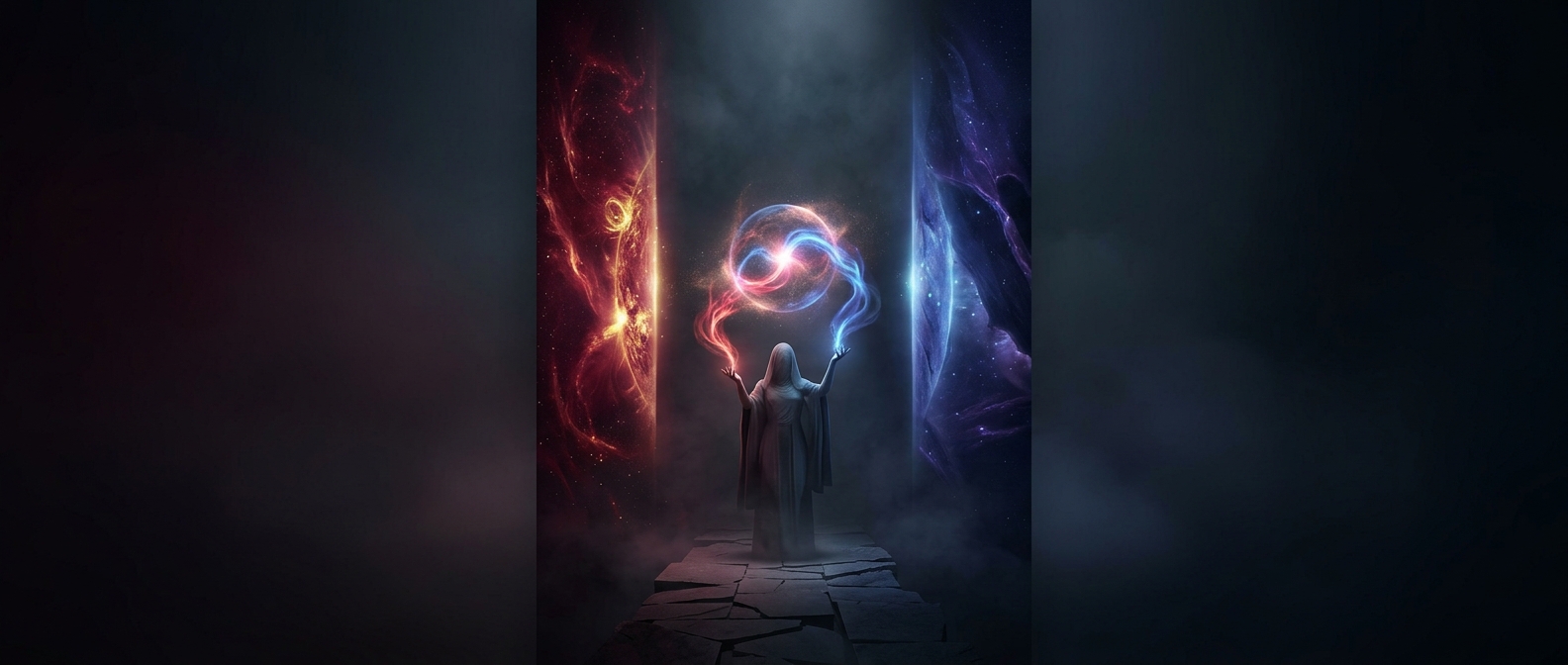
What “non-duality” means
Non-duality is a family of spiritual ideas, not one single doctrine. The word means “not two”: at the deepest level, reality is not divided into separate, self-contained selves and an entirely separate world. Some traditions describe this as the individual self being one with an ultimate reality; others focus on how the sense of division arises. These are claims about the nature of experience and reality, not findings established by science.
The self as a boundary, not an island
In ordinary life, it is useful to distinguish “me” from “you.” We have different bodies, memories, needs, and responsibilities. Non-dual teachings do not necessarily deny those practical differences. They question whether the separate, independent self we imagine behind them is as solid or ultimate as it feels.
A person may notice that thoughts, emotions, and sensations change from moment to moment, while the feeling of being a distinct observer seems continuous. Different schools interpret that observation in different ways. Some use meditation or self-inquiry to examine the sense of “I”; others emphasize teachings, devotion, or contemplation. The aim is not simply to adopt the slogan that everyone is one, but to investigate what the sense of separation rests on.
What changes in an argument
Seen through this lens, conflict can be approached with less insistence that the other person is wholly separate from one’s own concerns. Their fear, frustration, or mistaken assumptions still matter; non-duality does not make disagreement disappear or excuse harmful behavior. Rather, it can loosen the impulse to treat every disagreement as a contest between fixed, isolated selves.
That shift may invite curiosity: What is each person protecting? What part of the conflict comes from misunderstanding? The practical implication is modest but striking: a boundary can be necessary in daily life without being the final truth about what connects us.