Why the Electric Car Fit the Early City
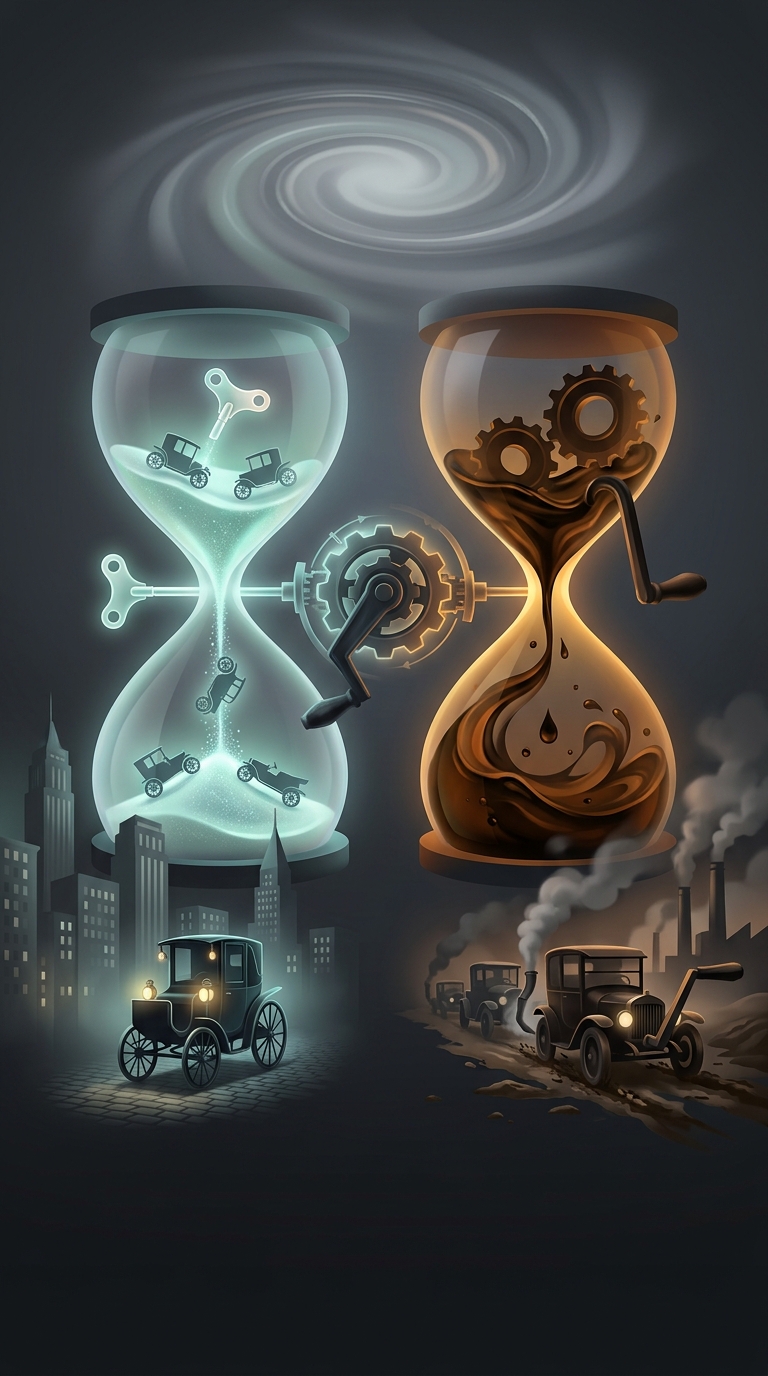
Around 1900, an electric car had a practical advantage at the curb: turn a switch, and it moved. A gasoline car’s engine had to be started by hand, usually with a crank. The driver fitted the crank to the front of the engine and pulled it around to get the cylinders firing—a strenuous task that could also make the crank kick back. Electric motors avoided that routine, as well as the fumes and noise of a running gasoline engine.
Those advantages mattered most on short urban trips, where a car could return to a familiar place to recharge. But an electric car depended on stored battery power. Longer journeys meant planning around limited range and the availability of places to recharge; a gasoline car could keep going wherever fuel could be obtained.
The Starter Changed the Tradeoff
An electric starter used a small motor powered by a battery to turn a gasoline engine until it began running on its own. That removed a conspicuous daily inconvenience and made gasoline cars easier for more people to operate. It did not give them the electric car’s quietness or lack of exhaust, but it narrowed the usability gap at the very moment gasoline vehicles were becoming easier to build and buy in large numbers.
Mass production helped push that shift further: once gasoline cars were made cheaply and widely, more drivers could find fuel and service for them. The electric starter was therefore not the sole reason electric cars lost ground. It helped erase one of their clearest advantages while manufacturing and fuel access favored their rivals.
A small motor changed what starting a car felt like—and helped make the hand crank, once a routine part of driving, an artifact of an earlier automotive age.