How a tapered wheelset follows a curve
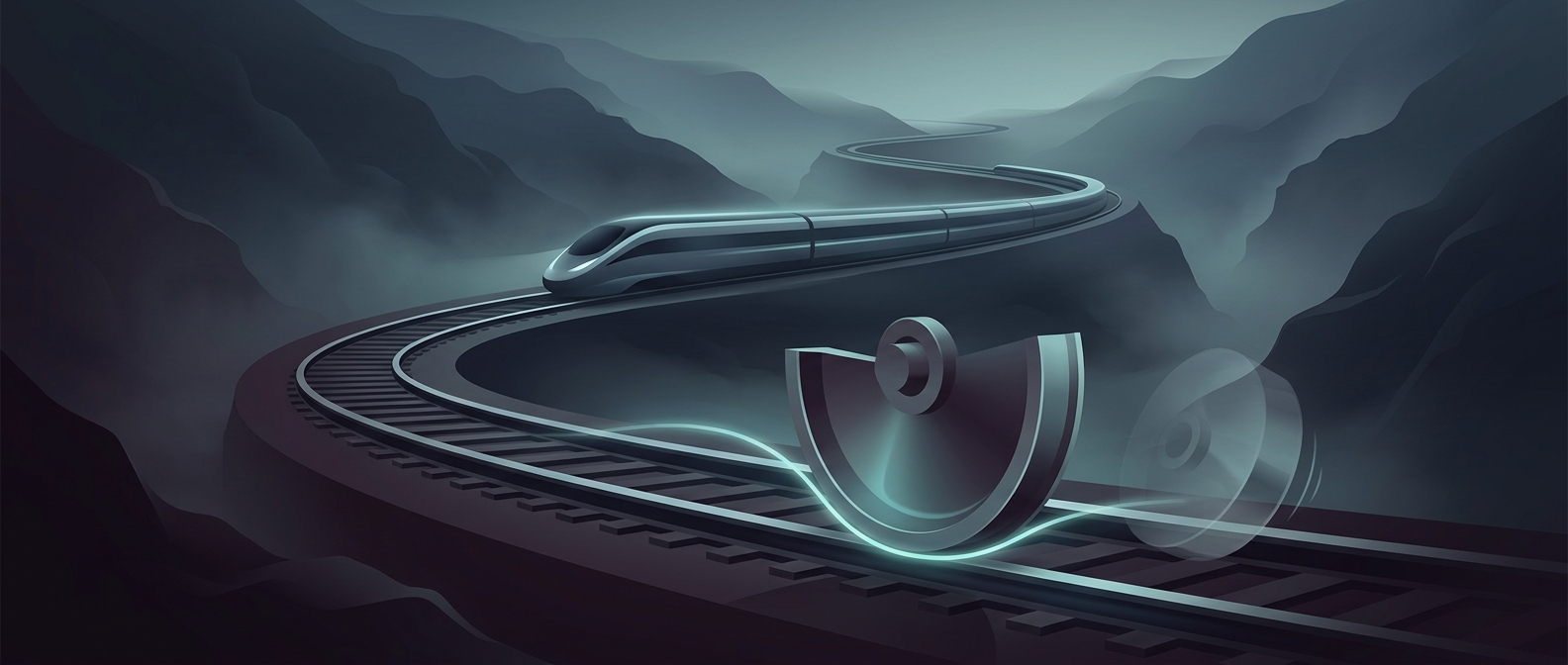
A railcar’s two wheels are joined by a rigid axle, so they cannot spin independently. That sounds like a problem on a bend: the wheel on the outside must travel farther than the one on the inside. The solution is built into the wheel profile. Each tread—the surface that rolls on the rail—is slightly tapered rather than perfectly cylindrical.
As the wheelset shifts sideways on a curve, the outer wheel contacts the rail on a wider part of its tread. That gives it a larger effective rolling radius: each turn carries it farther along the track. The inner wheel contacts a narrower part, so it advances less per turn. The axle still turns as one unit, but the two wheels cover different distances.
The shape also helps keep the train centered
On straight track, a sideways shift puts one wheel on a larger rolling radius than the other. Because the wheels are locked together, that difference steers the wheelset back toward the middle. This passive steering helps the train follow gentle curves without requiring a separate steering joint for each wheel.
The effect has limits. A very sharp bend may require the wheel flanges—the raised inner edges of the wheels—to help guide the train, and wheel shape and suspension must be designed to work together. But on ordinary curves, a small sideways movement is enough to turn the same axle into a simple differential: one side rolls farther, not because it spins faster, but because it rolls on a larger circle.