Why Pitch Can Crack and Creep
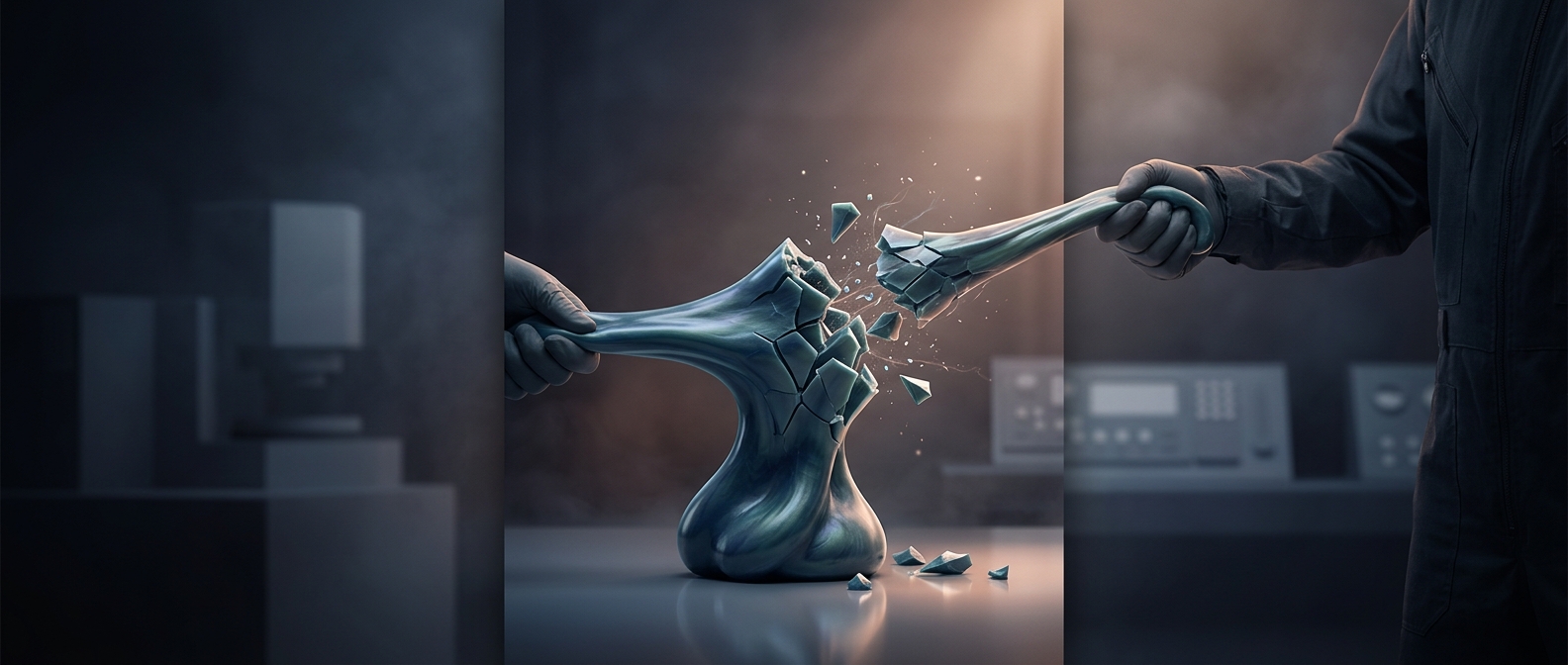
Pitch is a dense, tar-like material made from complex mixtures of hydrocarbons. At ordinary temperatures, it resists movement so strongly that a tap can make it snap like a brittle solid. Yet give it enough time, and it can deform under its own weight. Those behaviors are not contradictory: they reflect how quickly the material can respond to a force.
The Waiting-Time Effect
In a brittle material, stress can build faster than the structure can rearrange, so a crack opens before the material yields. Pitch’s molecules are not locked into a rigid crystal. They can shift past one another, but their rearrangement is extraordinarily slow. A sudden blow acts on a timescale too short for that slow motion, making the pitch seem solid. Gravity applies a much smaller force continuously, leaving far more time for gradual deformation.
This is called viscoelastic behavior: a material combines an elastic response, in which it resists and may spring back, with a viscous response, in which it flows. Which side dominates depends partly on how long the force acts.
A Flow Too Slow to Notice
Imagine pressing pitch briefly, then leaving the same force in place. The brief push may produce little visible movement; over a long interval, the material can gradually change shape. Its properties have not suddenly switched from solid to liquid. Rather, the slow molecular motion becomes noticeable only when the observation lasts long enough.
That distinction matters beyond pitch. Many materials that feel solid in everyday use can slowly deform over long periods, while liquids can resist rapid motion. The label “solid” or “liquid” alone does not tell the whole story: the timescale of the test matters, too.