Why a soap bubble rounds itself out
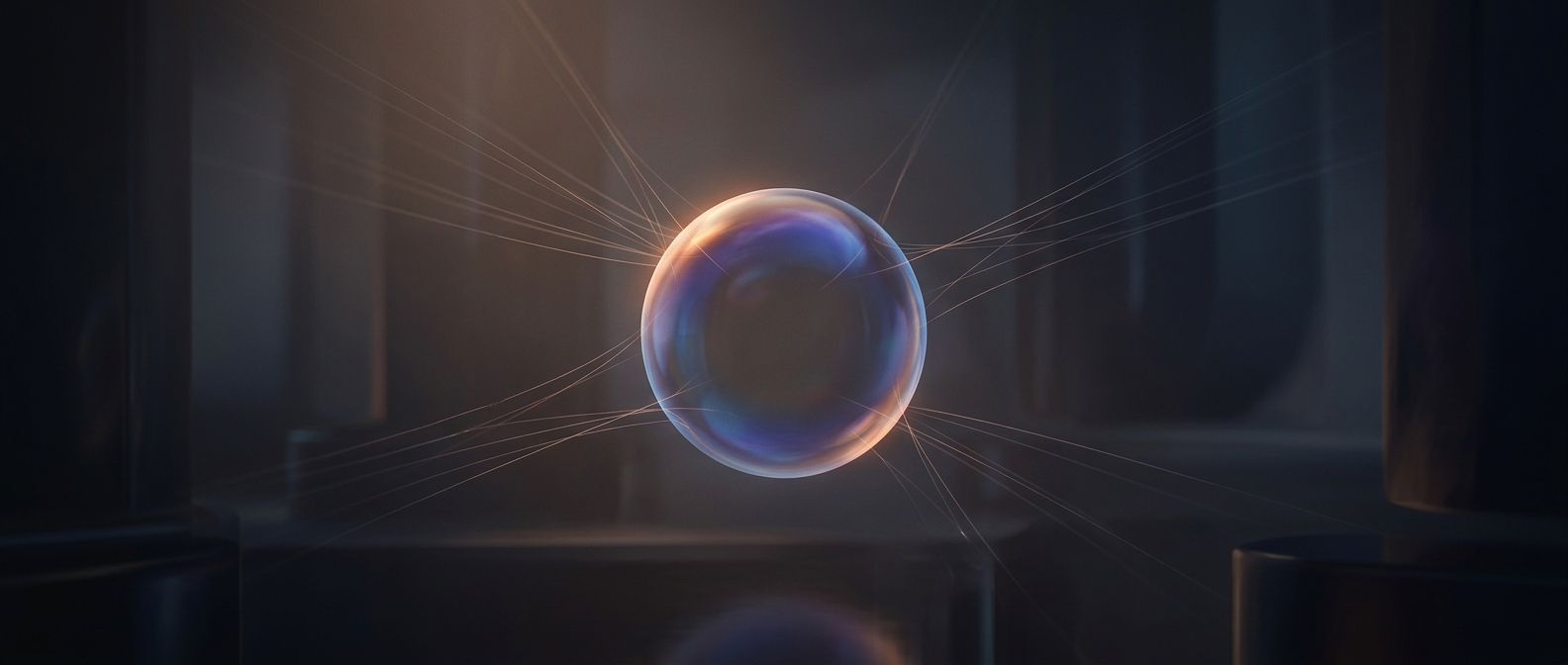
A bubble’s film behaves a little like a stretched elastic skin. Water molecules attract one another, so the liquid surface tends to contract. Soap molecules make the film more stable, but the film still pulls inward, trying to reduce the area it covers.
For a fixed amount of trapped air, a sphere encloses the most volume with the least surface area. That makes it the shape the film can settle into without having to stretch across extra area. The bubble’s roundness is therefore not a push from the air alone: it is the result of air pressure inside balanced against the film’s inward pull.
Why bubbles are not always perfect spheres
That balance works best when nothing else disturbs the film. A bubble resting against a surface flattens where it touches; air currents can stretch it; and gravity can make a large bubble sag. The film also has to remain intact: as water drains downward and evaporates, thin spots become more likely to break.
A free-floating bubble can look perfectly spherical because the film is evenly pulled in every direction. The moment it meets a wall or another bubble, the geometry changes. Where bubbles press together, they share a boundary rather than each keeping a complete spherical surface—a small reminder that the sphere is the film’s preferred shape only when it has room to form one.