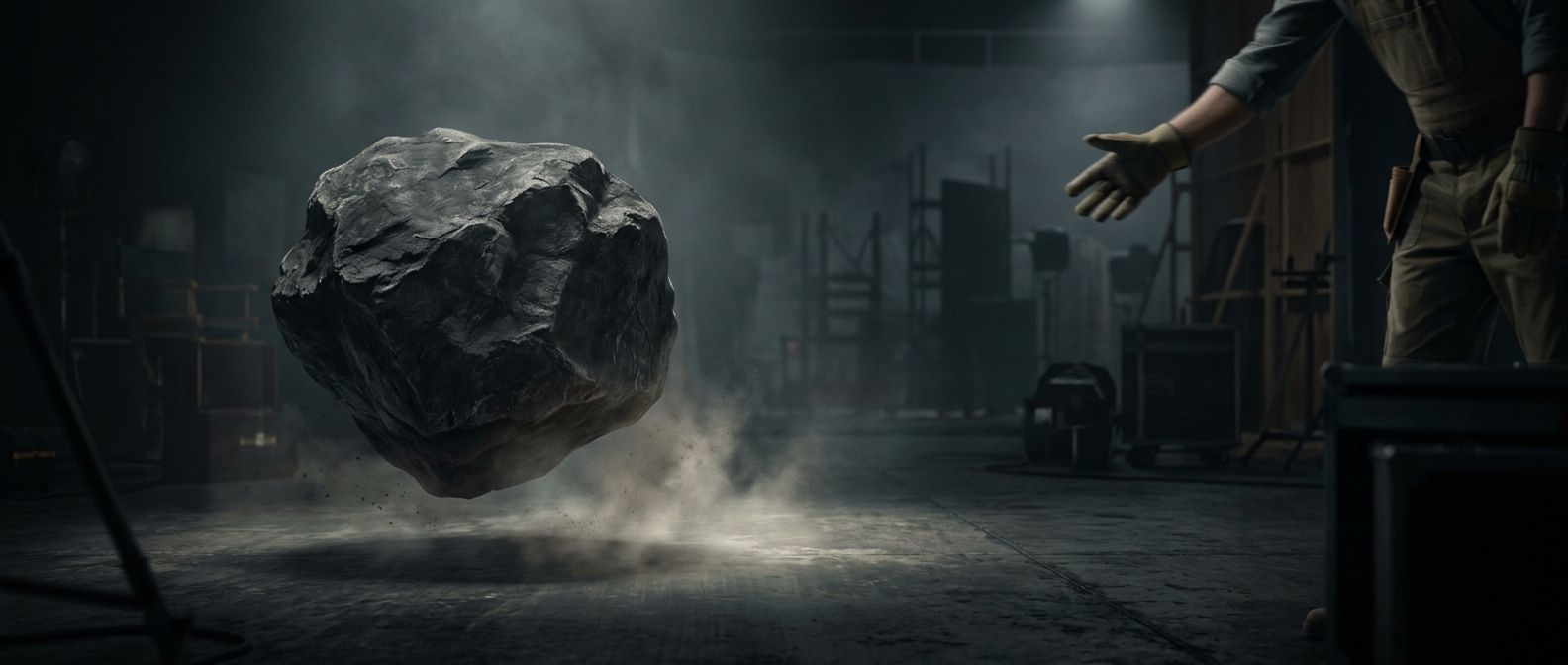
Building a Boulder That Can Survive a Drop
A rock that looks massive on camera does not have to be made of stone. For some movie props, the hidden structure is polyurethane foam—a lightweight material that can compress when it hits the ground. A hard outer coating gives the surface a more convincing rocky look and feel, while paint and texture help sell the illusion in close shots.
That combination solves a practical problem: a real boulder is dangerous to move or drop, and a solid imitation could be heavy enough to injure someone or damage a set. A foam prop is easier to handle and can be made large without carrying the same weight as an actual rock.
Why It Bounces
When the prop lands, the foam deforms and then pushes back toward its original shape, returning some of the impact energy as motion. The coating can affect how the prop flexes, but it does not make the lightweight core behave like stone. The result is a useful cinematic contradiction: a boulder-shaped object that looks heavy yet can rebound.
That bounce is not a flaw in the illusion so much as a production tradeoff. The prop must read as a threat from the audience’s viewpoint while remaining manageable for the people who build, move, and film it. In a carefully framed shot, the camera supplies the apparent scale; the foam makes the stunt safer and the reset easier.