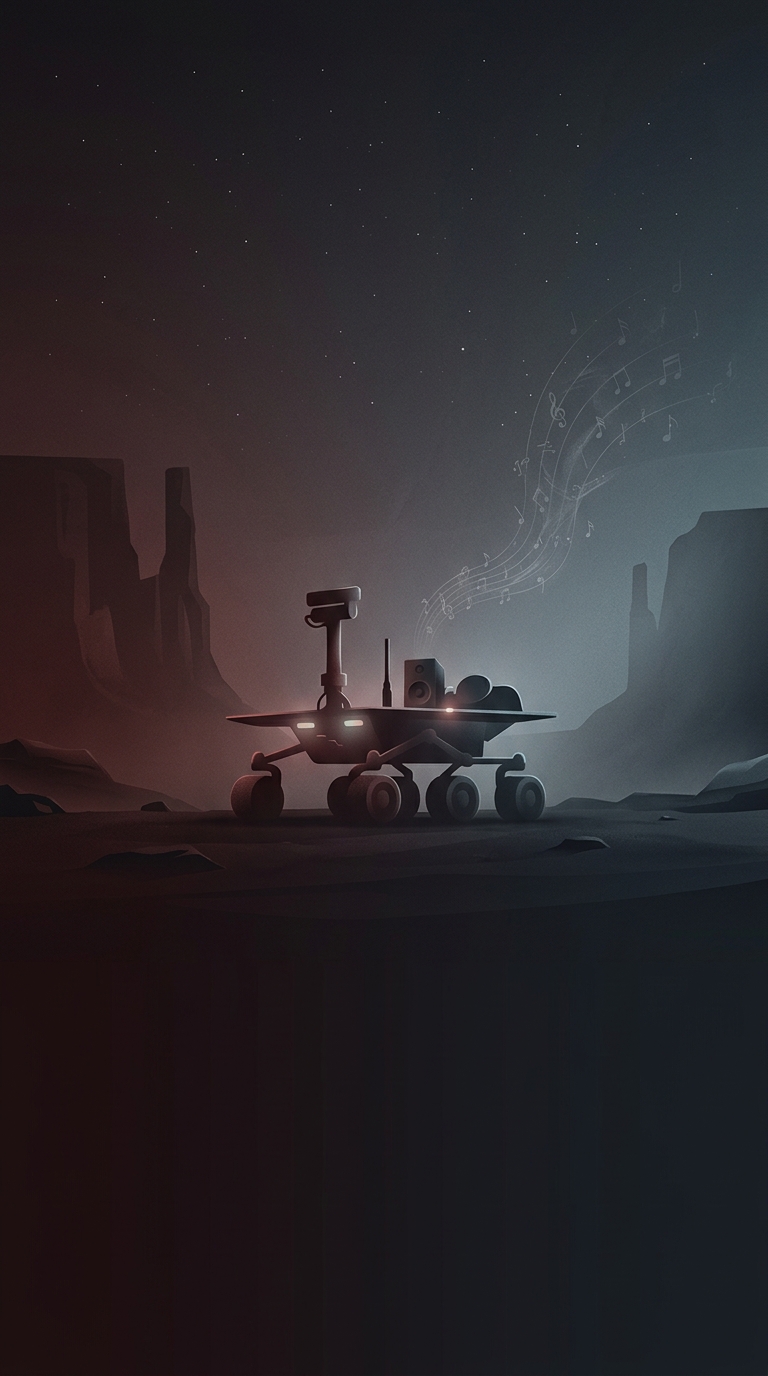
How Curiosity Made a Birthday Tune
Curiosity did not have a mouth or a musical instrument. To mark its first year on Mars, engineers sent it a sequence of commands that made its onboard Sample Analysis at Mars (SAM) instrument produce vibrations corresponding to the notes of “Happy Birthday.” SAM normally helps analyze material collected by the rover; in this case, its hardware became a simple sound-making device.
The result was closer to a brief mechanical melody than a human voice. Curiosity had no audience on Mars, and the tune was not a message that another machine or life-form needed to understand. Its “birthday song” was a playful use of equipment already on the rover.
A Robot’s Birthday Runs on Earth Time
A rover cannot celebrate spontaneously in the human sense. Engineers plan its actions on Earth, then send commands across the vast distance to Mars. Because radio signals take time to travel between the planets, the rover cannot be steered moment by moment like a remote-controlled car. Once the instructions arrived, Curiosity carried them out on its own.
That distinction makes the serenade a small demonstration of how planetary exploration works: people choose the task, but a machine on another world has to execute it using its own hardware and stored commands. The scene was both technical and whimsical—a laboratory instrument turning a carefully planned sequence into a tune on a cold, distant planet.