A golf swing shaped by a spacesuit
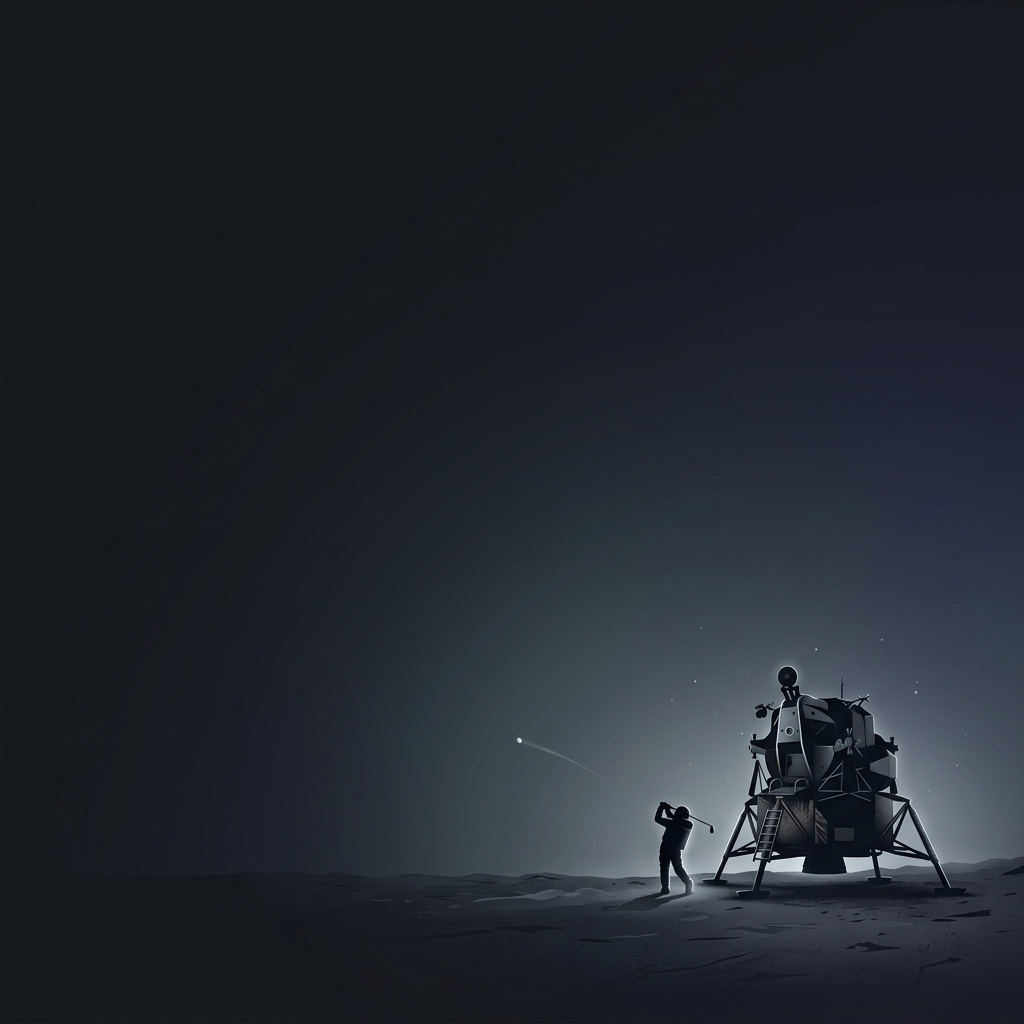
Alan Shepard’s lunar golf shot was less a conventional swing than a workaround for the Apollo spacesuit. The suit’s stiff layers helped protect him from the Moon’s airless, harsh environment, but they also resisted bending and twisting. Shepard could not freely rotate his shoulders or swing with both arms as he would on a course on Earth, so he used a six-iron one-handed.
That constraint mattered more than the club. On Earth, a powerful golf swing depends on coordinated movement through the legs, hips, torso, and arms. A bulky suit limits that chain of motion, turning a familiar action into a small engineering problem: how to make contact with the ball while keeping balance and control in a rigid garment.
Why the ball seemed to travel so far
The Moon’s gravity is much weaker than Earth’s—about one-sixth as strong. Once a ball was hit, lunar gravity pulled it downward less strongly, so it could remain in the air longer than it would after a comparable shot on Earth. The Moon also has no atmosphere to slow a moving ball through air resistance. Together, those conditions made a long flight possible even without a full, powerful golf swing.
The lack of air also changes what “a shot” looks like: there is no breeze to push the ball sideways, and no atmospheric drag to sap its speed. But the weaker gravity does not magically add force to the swing; it changes what happens after the ball leaves the club.
A small demonstration of lunar constraints
The shot is memorable because it joined an ordinary game to the realities of working on another world. Shepard had to adapt his movement to protective equipment, while the Moon’s environment altered the ball’s flight. It was a playful moment, but also a compact demonstration of how exploration depends on designing around limits—what a person can move, what a suit allows, and how unfamiliar physical conditions change the result.