Why Metatron Is Called the “Lesser YHWH”
In the Zohar, the medieval Jewish mystical work associated with Moses de León, Metatron occupies a perilous middle ground: he is a heavenly being who carries divine authority into a created universe, but is not God. The title “Lesser YHWH” signals that proximity. It does not mean the text simply presents two equal gods; it marks Metatron as a powerful representative whose status could be mistaken for divinity.
That ambiguity helps explain why the description feels awe-inspiring and unsettling. A mediator must be close enough to the divine to act on its behalf, yet remain distinct from it. Metatron’s extraordinary rank makes that distinction harder to keep in view.
From Enoch to a Celestial Scribe
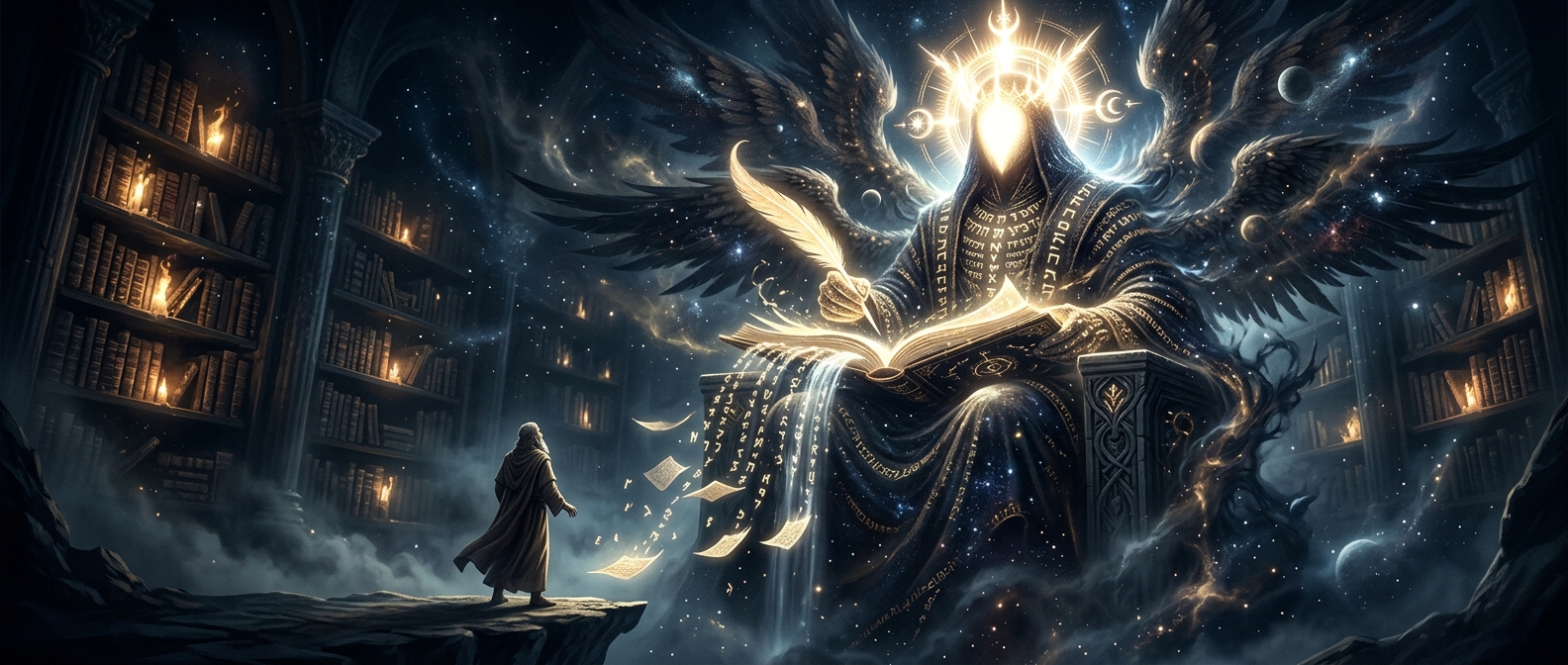
The Zohar connects Metatron with Enoch, the biblical figure who is taken up to heaven. In the mystical account, Enoch’s transformation turns a human life into a heavenly office: he becomes a celestial scribe, a figure who records or orders what unfolds in the divine court.
Scribing gives the image a practical edge. A scribe stands between an authority and the world that receives its commands, preserving and transmitting what would otherwise remain inaccessible. Metatron’s role therefore makes him more than a spectacular angel: he embodies the passage between divine power and the ordered universe.
Why Give an Angel Millions of Eyes?
The blazing eyes amplify that role into a vision of overwhelming awareness. They suggest a being who can witness the cosmic order on a scale no human observer could manage. The image is not a biological description; it makes Metatron’s reach visible through impossible abundance.
The result is a figure who looks almost like a divine double while remaining a servant and intermediary. That tension is the point: Metatron’s majesty makes divine authority imaginable at the edge of the human world, while his subordinate status keeps the boundary between angel and God in place.