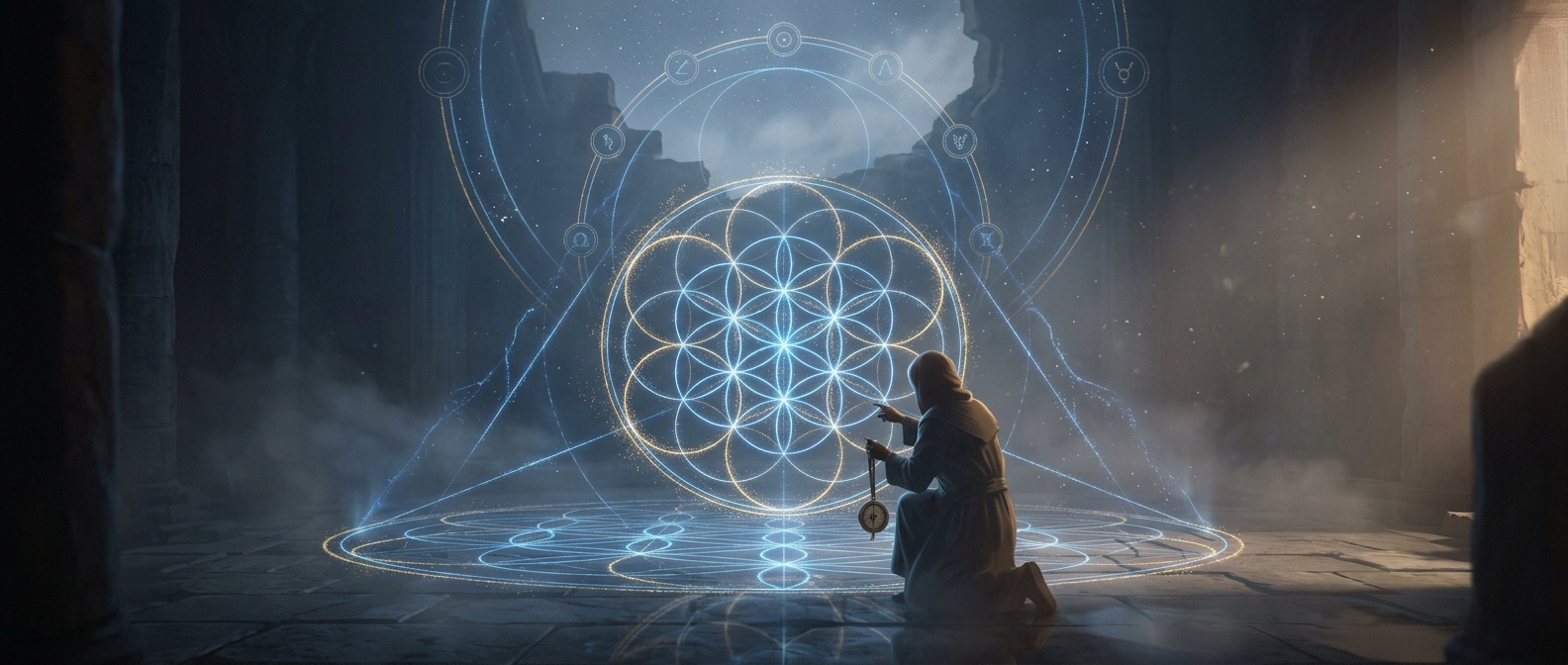
How the 19-circle pattern is built
The familiar 19-circle version of the Flower of Life is arranged in three layers: one circle at the center, six around it, and twelve in the outer ring. Each circle has the same radius, and neighboring centers are spaced one radius apart. That spacing makes the circles cross in a repeating pattern rather than merely touch.
The geometry is closely related to a hexagonal grid. Place the first circle, then use its circumference to locate the centers of the six surrounding circles. Continue outward in the same rhythm to form the next ring. Because every center must land at the correct distance, even a small shift can make the intersections look uneven. A compass helps keep the radius fixed as the pattern grows.
Why the pattern suggests connection
The repeated overlaps give the design its visual force: no circle stands entirely apart from the others, and the same curves recur across the whole figure. That makes it easy to read the pattern as a symbol of interdependence or a unified creation. Those are interpretations attached to the design, not properties established by its geometry.
The count of nineteen describes this particular arrangement, not every drawing called the Flower of Life. Its orderly construction is part of the appeal: a set of simple circles produces a dense figure in which each curve belongs to a larger pattern.