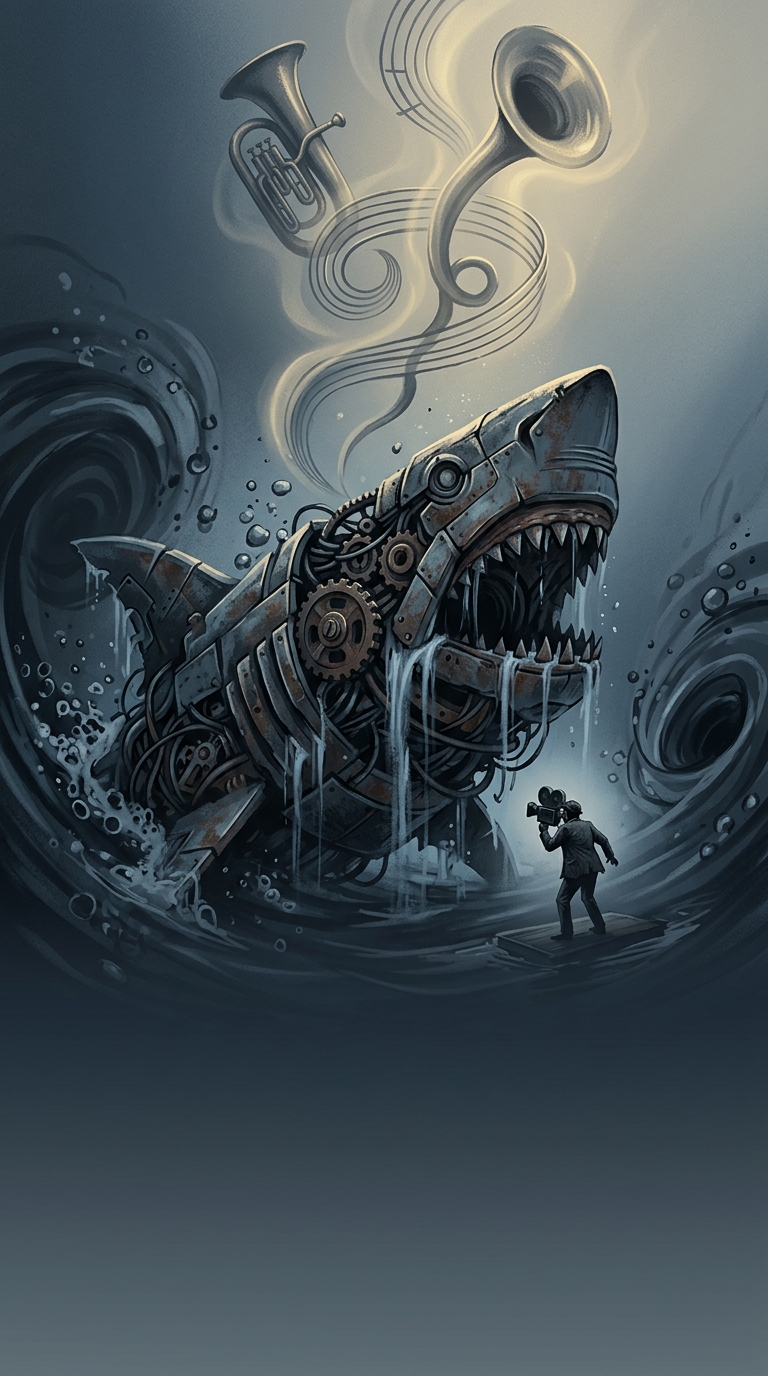
When the Shark Wouldn’t Cooperate
For Jaws, Steven Spielberg and his crew built full-size mechanical sharks that could open their jaws and move through the water. The saltwater setting made the machines difficult to operate: mechanisms malfunctioned, and the shark could not be relied on to perform on cue. The production’s nickname for the mechanical shark was “Bruce,” but the trouble was more complicated than a single prop simply sinking like a stone.
The failures changed the way the film had to be shot. Rather than build every attack around a clear view of the shark, Spielberg increasingly showed what its arrival did: a body disappearing beneath the surface, a fin cutting through the water, or swimmers reacting to something just out of sight. Yellow barrels attached to the shark also let the audience track its movement without seeing the whole animal.
A Mechanical Problem Became a Suspense Tool
With the threat partly hidden, viewers had to imagine its size and position. That uncertainty made ordinary stretches of water feel dangerous—and gave the film room to build dread before a full reveal. The limitation became a feature of the storytelling, though the crew still used the mechanical shark when a visible attack was needed.
John Williams’s score helped make those unseen approaches legible. Its famous alternating two-note motif is played by low strings, not a tuba; as it grows faster and louder, it signals that the shark is drawing near. The music and the restricted views worked together: one warned the audience, while the other withheld the evidence. A malfunctioning effect thus helped shape Jaws’s most durable suspense technique: letting viewers fear what the camera does not show.