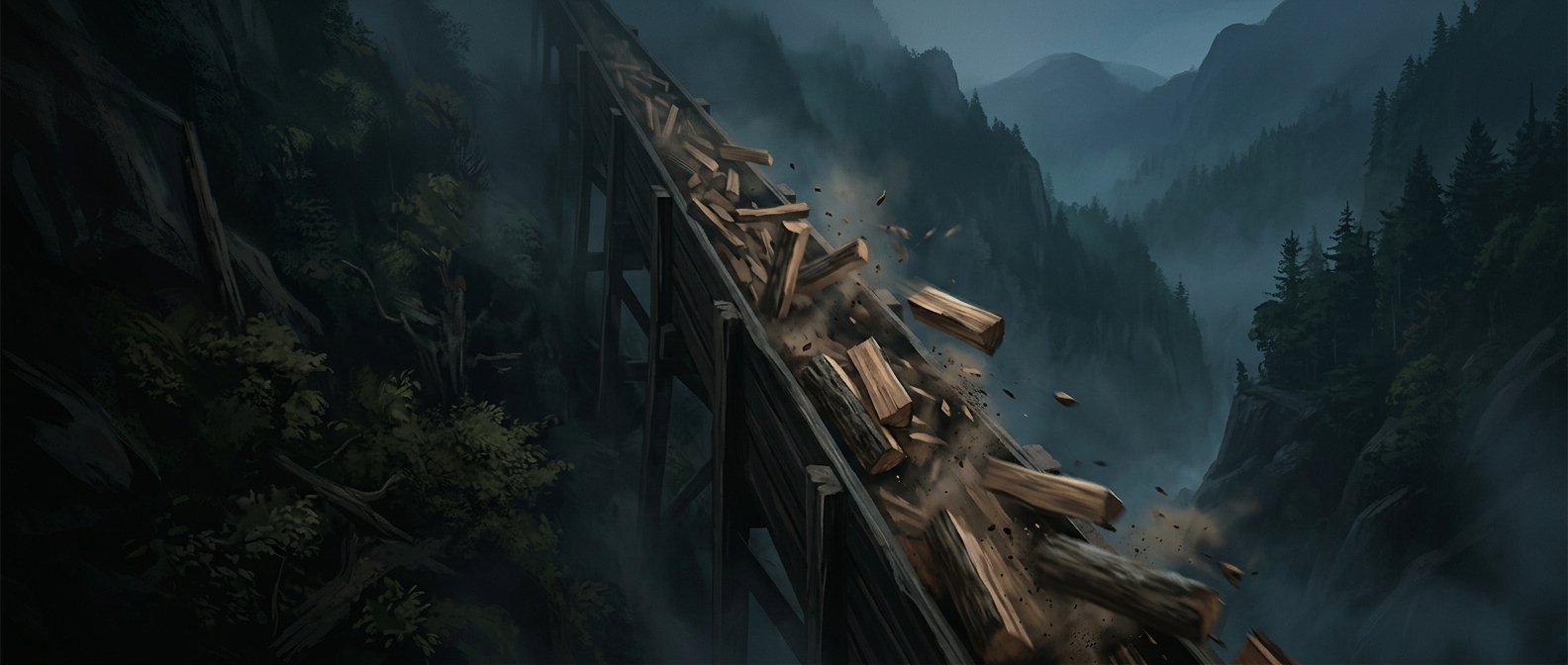
Turning a mountainside into a timber route
A steep slope could move timber from a remote cutting site to a road, river, or mill—but only if the logs stayed on a predictable path. A wooden chute did that by enclosing the route between raised sides. Instead of bouncing freely down rough ground, each log slid along a smooth channel, with the walls helping keep it from veering into trees or rocks.
Gravity supplied the force. Water, when available, ran along the chute to wet the wood and reduce scraping resistance. That mattered because a dry log rubbing against boards could slow, snag, or jam; a slick channel let the load travel farther with less interruption. The chute’s grade had to be steep enough to keep logs moving, but the route also needed a manageable line through the terrain. A bend or uneven section could turn a simple slide into a blockage or a dangerous impact.
The hard part was controlling the landing
Once a log entered the chute, workers had limited ability to stop it. The lower end therefore had to deliver timber into a place where it could be caught, gathered, or transferred onward. A fast-moving log arriving among workers or piled timber posed an obvious hazard, so the landing area was as much a part of the transport system as the slope itself.
The method traded machinery for construction and gravity: crews built a fixed wooden lane, then let the mountain do the hauling. It could connect cut timber to the next leg of its journey without a vehicle climbing the slope. But every log’s progress depended on the condition of the channel—and on having somewhere safe for that slide to end.