Why Lower Pressure Changes the Boiling Point
A liquid’s molecules are always moving, and some escape from its surface into the air as vapor. The vapor also pushes back on the liquid. As temperature rises, more molecules can escape, increasing that vapor pressure. Boiling begins when vapor inside the liquid can push outward strongly enough to form bubbles that do not collapse under the surrounding pressure.
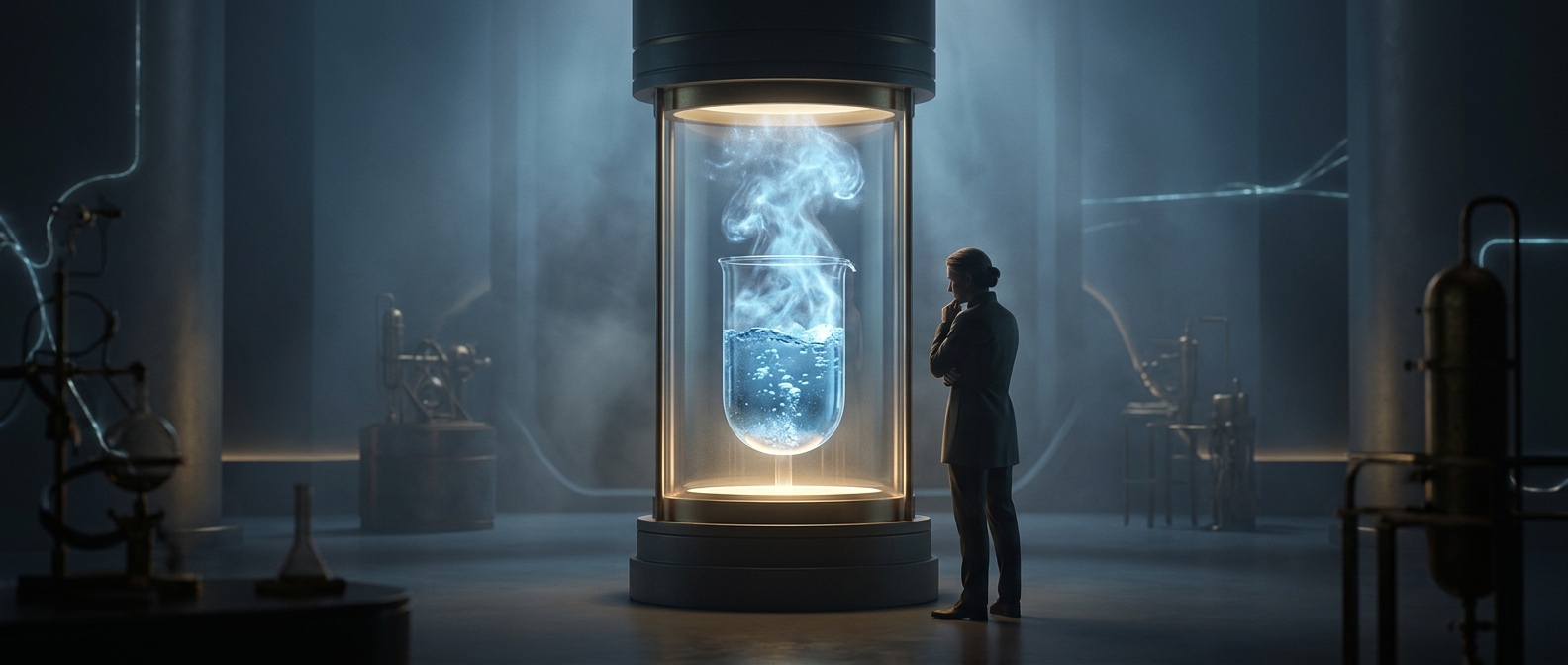
In ordinary air, water must get hot enough for its vapor pressure to match atmospheric pressure. Reduce the pressure around it, and that threshold falls. In a sufficiently strong vacuum, water at room temperature can form vapor bubbles without being heated to its familiar boiling point.
Why the Boiling Liquid Gets Colder
Escaping molecules take energy with them. The molecules most likely to leave are among the faster-moving ones, so their departure lowers the average energy—and therefore the temperature—of the liquid that remains. This is evaporative cooling, the same basic effect that makes wet skin feel cool as water dries.
Boiling can intensify that energy loss because vapor forms throughout the liquid, not only at its surface. If pressure stays low and heat is not supplied from the surroundings, the liquid can cool rapidly. Water may even begin to freeze: the same process that produces bubbles is removing the energy needed to keep it liquid.
So “boiling” does not necessarily mean “getting hotter.” It describes a change of state driven by the balance between vapor pressure and outside pressure. Under the right conditions, a liquid can bubble at room temperature and cool itself as it does.