Reading the sky through Iceland spar
Iceland spar is a clear form of calcite with an unusual optical property: it bends light into two separate rays. Looking through a piece can make one object appear as a doubled image. Because the two rays respond differently to polarized light—light whose waves are aligned in a particular direction—their relative brightness changes as the crystal is turned.
That change can reveal the direction of polarization in the sky. Sunlight scattered by air molecules becomes polarized in a broad pattern around the sun. Even when clouds hide the sun itself, some of that pattern may remain visible, offering clues to the sun’s hidden position.
From a light pattern to a heading
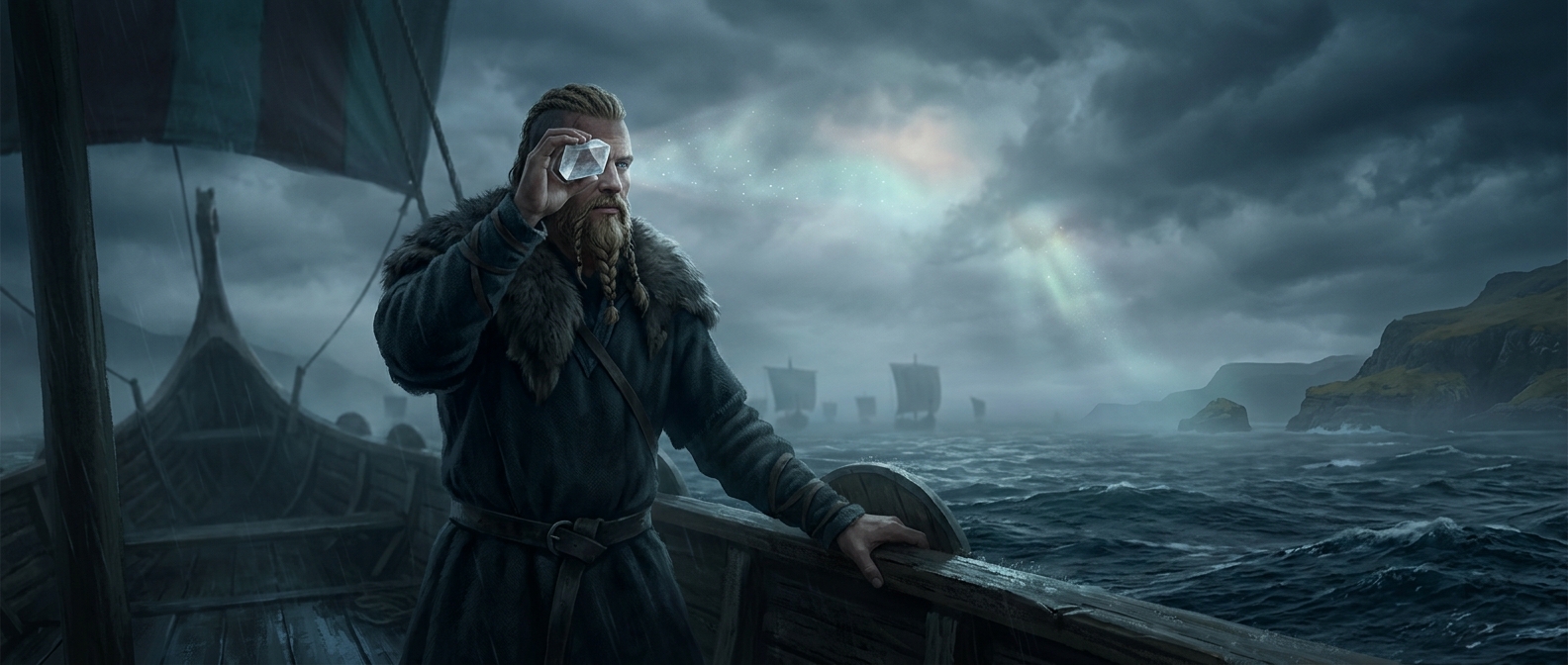
A navigator could compare the light through the crystal while turning it, then use the resulting polarization direction to estimate where the sun lay. With the sun’s position and the time of day as guides, a sailor could orient a course. The crystal would not point north on its own: it was a potential way to recover a useful celestial reference when direct sunlight was obscured.
The method would depend on conditions and skill. Cloud cover can weaken or distort the pattern, and interpreting it takes more than simply holding up a stone. It is best understood as one possible aid among the observations a sailor might use, not a device that guarantees a direction in any weather.
An intriguing possibility, not a settled record
Medieval accounts mention a “sunstone,” and Iceland spar has been proposed as a candidate. But there is no conclusive evidence that Vikings routinely used calcite crystals to navigate. The optical mechanism is real; its historical use remains uncertain.
That distinction is what makes the idea compelling: a small transparent crystal can turn a hidden feature of the sky into a navigational clue, even though the surviving evidence cannot confirm exactly how often sailors relied on it.