Why a Corn Maze Can Make You Feel Lost
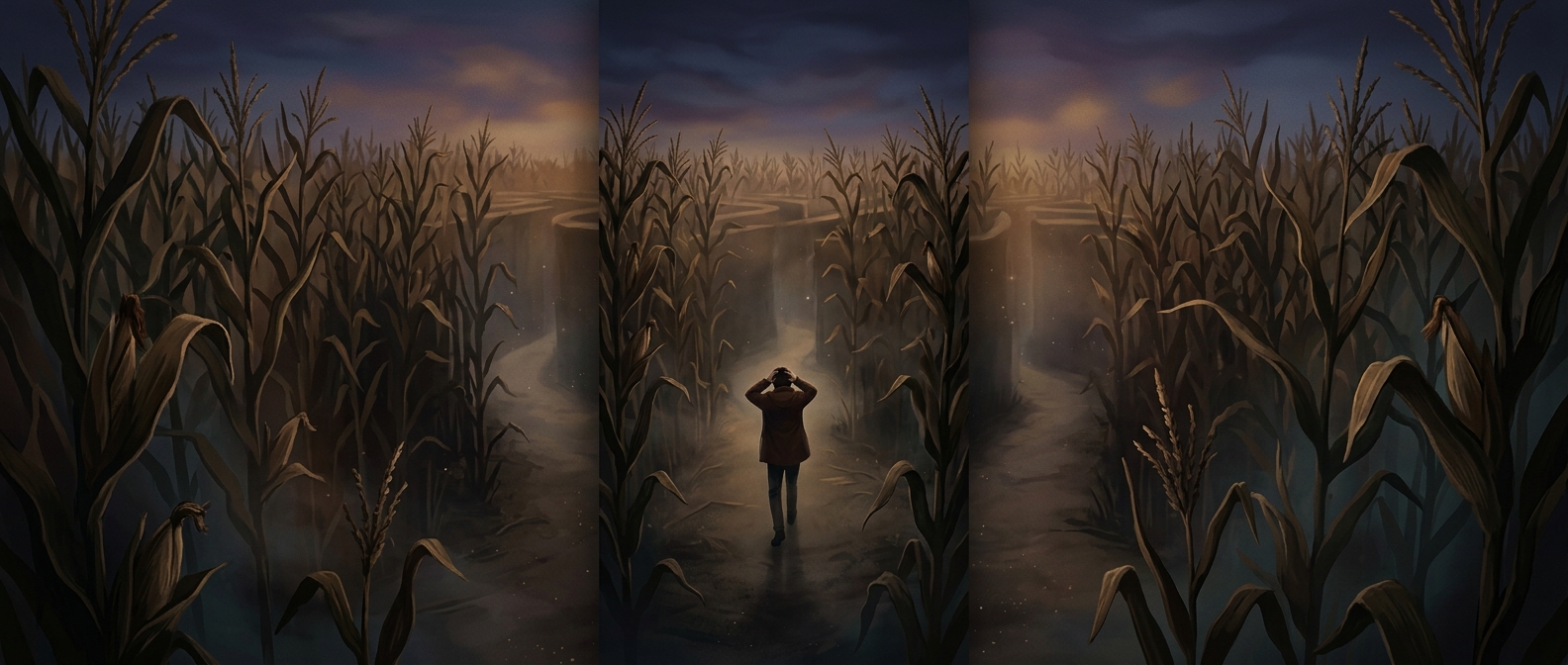
A corn maze removes the clues people normally use to keep their bearings. Tall stalks hide distant landmarks, while rows of similar height and color offer few visual differences. Once the entrance disappears from view, a turn that seemed easy to remember can become hard to place: was it the left branch before the dead end, or the one after it?
Every Turn Adds to the Puzzle
Finding a route depends partly on remembering a sequence of choices and partly on recognizing where you are. In a maze, both jobs get harder. Repeated-looking corridors are easy to confuse, and a wrong turn can make earlier choices blur together. The maze is not changing, but your mental map has fewer distinct landmarks to anchor it.
That is the design tension behind a good maze: choices must feel challenging without becoming impossible to follow. Dead ends and loops create uncertainty; clearer landmarks or a route back out can make that uncertainty manageable. Without such cues, simply retracing your steps may not help if you cannot tell which branch you came through.
Why Dusk Changes the Experience
As daylight fades, visibility drops and the time left to navigate feels more limited. That pressure can make each uncertain turn feel more consequential, even when the route itself has not changed. The shift from amusement to worry is part of the maze’s hidden challenge: it tests not just direction-finding, but how well you can make decisions when familiar cues—and confidence in your own memory—are scarce.