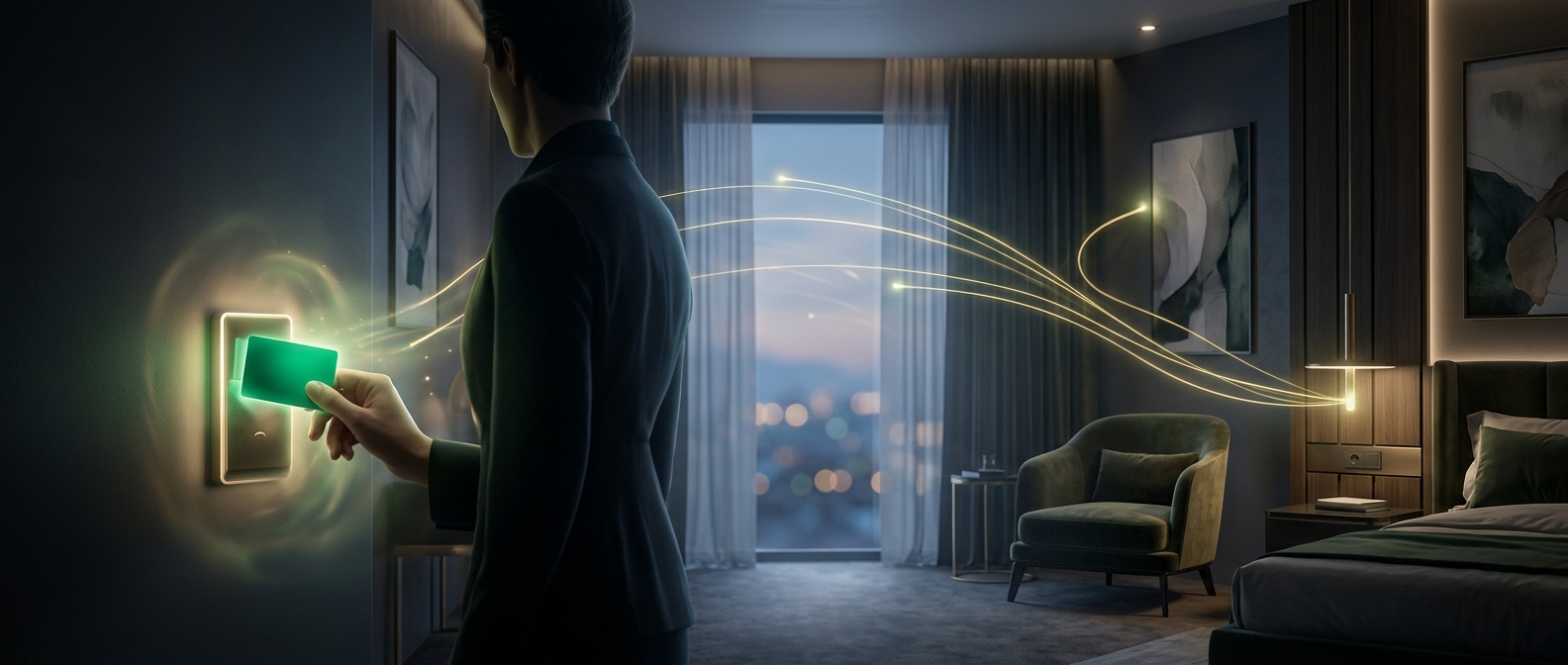
Why a Room’s Power Slot May Not Check Your Key
In some hotel rooms, the card-shaped slot by the door is a simple occupancy control. Inserting a card presses a small switch—or interrupts a sensor beam—which tells a controller to supply power to selected room circuits. The slot responds to an object of roughly the right shape, not to information stored on a hotel key.
That is why another plastic card can sometimes do the job. A loyalty card or gift card may be enough to trigger the switch, even though it cannot unlock the door. The door lock and the room’s power control are separate systems: the lock must verify an authorized credential, while a basic power slot only needs to detect that something is inserted.
A Small Control With an Energy Tradeoff
Hotels use these controls to reduce the chance that lights and other connected equipment stay on in an empty room. When a guest removes the card, the controller can cut power to the circuits it governs. The slot usually does not control every outlet or appliance, and some rooms use more sophisticated systems that do check a key card or detect occupancy another way.
The design reflects a practical compromise: a simple switch is inexpensive and easy to use, but it cannot tell whether the inserted card belongs to a guest. So the familiar slot may look like part of the hotel’s security system while doing a much narrower job—turning selected room power on and off.