How a spinning boomerang steers itself
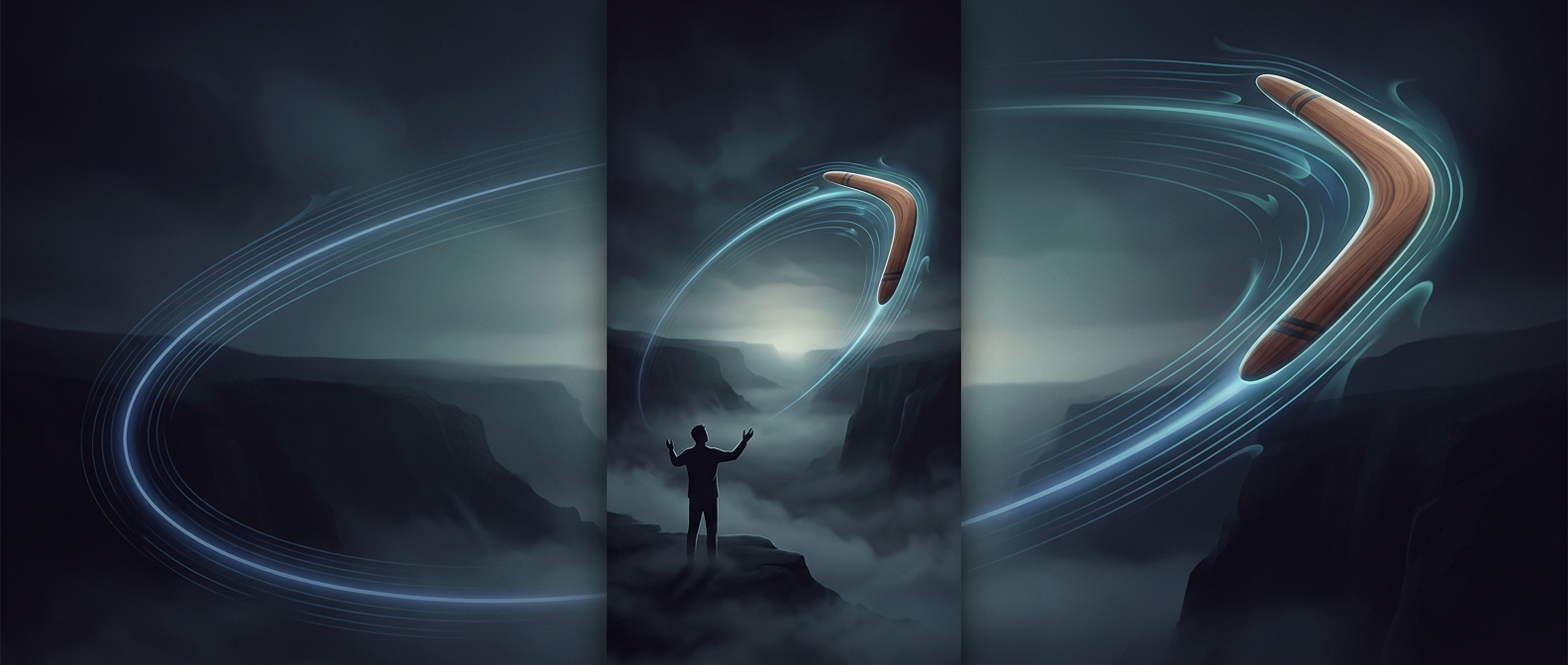
A returning boomerang is shaped like a pair of small wings joined at an angle. As it flies, each arm acts like an airfoil—a surface shaped to redirect air and generate lift. The boomerang’s forward motion combines with its rotation, so the arm moving forward through the air travels faster than the arm moving backward. That speed difference produces unequal lift and a twisting force.
Why the twist makes it turn
The force does not simply point the boomerang’s nose in a new direction. Its rapid spin gives it gyroscopic stability: like a spinning top, it resists having its rotation axis tipped. Instead, the twisting force changes the direction of that axis gradually. This effect, called gyroscopic precession, makes the boomerang’s flight path curve.
As the curve continues, the boomerang traces a broad loop rather than making a sharp U-turn. The returning path is therefore a consequence of two motions working together: the wings generate an uneven aerodynamic force, and the spin redirects that force into a steady turn.
Why a throw can miss
A boomerang’s return is not automatic. Its path depends on how it is thrown—especially its tilt, direction, and spin—as well as the wind. A throw with too little spin may not produce the stabilizing effect needed for a clean curve; a different tilt can send the loop wide or upward. The distinctive return is thus a carefully shaped flight, not a boomerang simply reversing course.