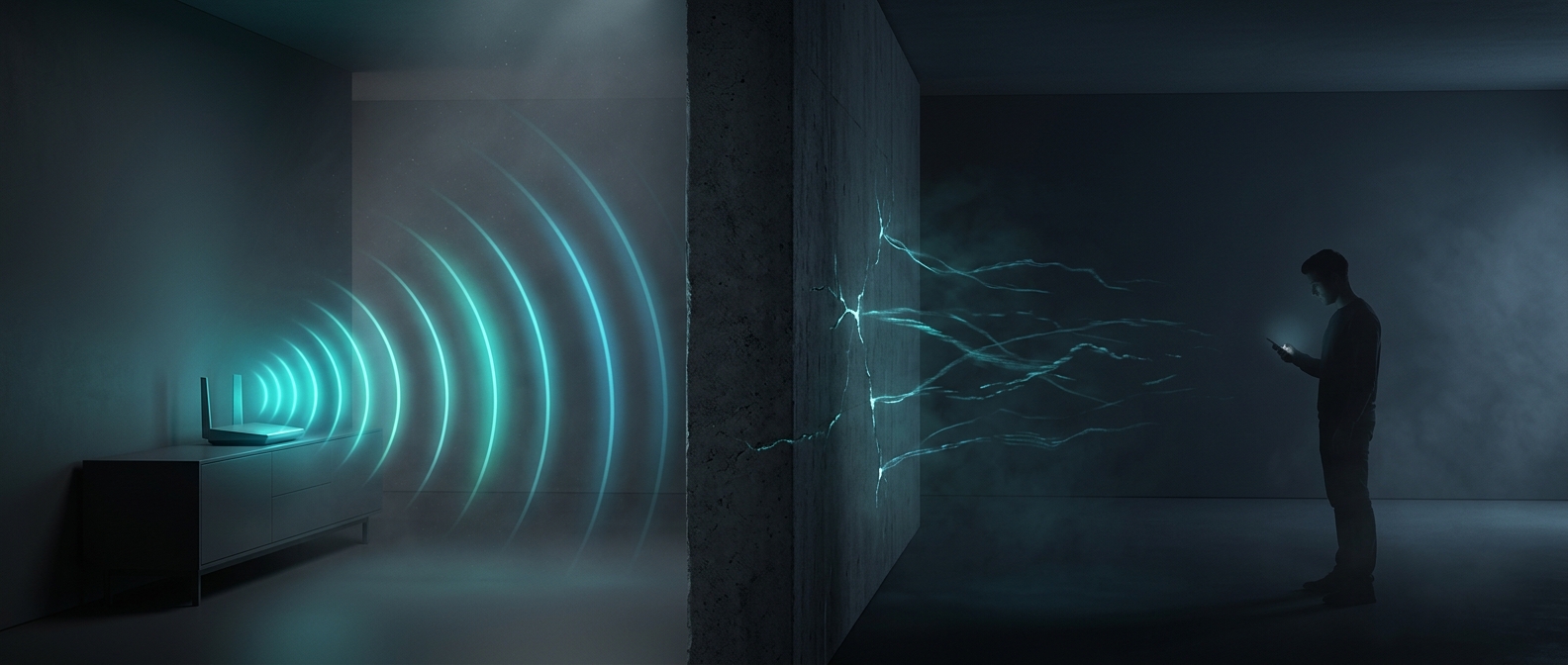
What a Wall Does to Wi-Fi
A router sends data as radio waves. When those waves meet a wall, the wall’s materials interact with them: some energy is absorbed and converted into tiny amounts of heat, some is reflected, and some continues through. The portion that emerges is weaker, so a device on the other side may receive data less reliably or at a lower speed.
How much gets through depends on what the wall is made of and how it is built. Dense materials such as concrete can absorb or scatter more radio energy than many lightweight interior walls. Metal can be especially obstructive because it reflects radio waves. Reinforcement, foil-backed insulation, pipes, and other layers inside a wall can matter too; the painted surface alone does not tell the whole story.
Why Frequency and Placement Matter
Wi-Fi uses radio bands at different frequencies. Higher-frequency signals generally lose more strength when passing through obstacles, though the exact result depends on the materials and conditions. A signal that travels well through an open space can therefore become much weaker after crossing a few dense barriers.
The router’s position changes the path the signal must take. A router tucked behind a television or placed at one end of a home may send much of its energy into obstacles before it reaches a device. Moving it into a more open, central location can help—not because the wall disappears, but because more signal can take a clearer route. Reflections may also let some signal reach a device indirectly, but those paths are often weaker or less stable.
That is why a nearby room separated by a substantial wall can have worse Wi-Fi than a farther spot along an unobstructed path: distance is only part of the journey the signal has to survive.