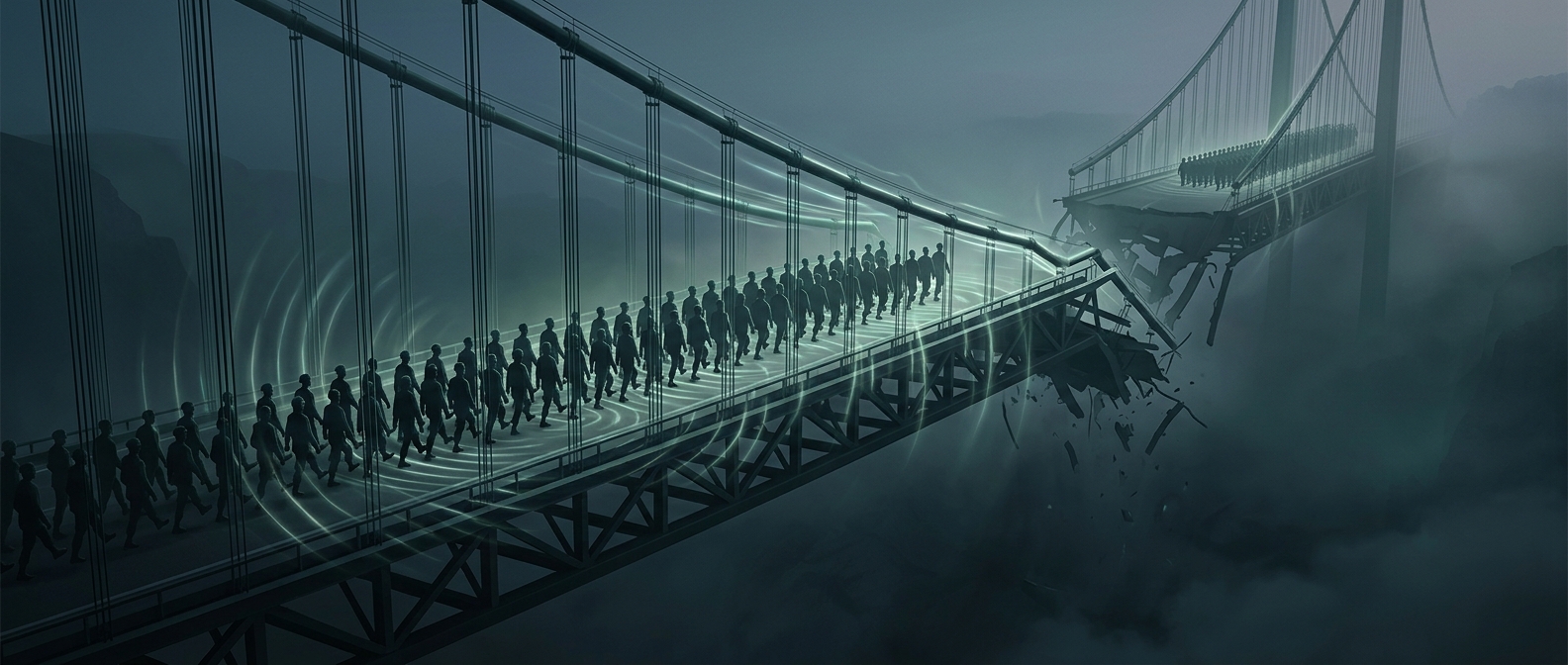
How a marching rhythm can make a bridge move
A bridge is not perfectly rigid. Each footfall bends it by a tiny amount, and the structure’s stiffness pulls it back. That back-and-forth motion has a natural frequency: the pace at which the bridge tends to vibrate when disturbed, much as a plucked ruler has a characteristic wobble.
A single step is usually too brief to matter much. The concern is a long sequence of steps arriving at regular intervals. If those pushes come at a rate that reinforces the bridge’s motion, each one can add a little energy to the same vibration. This is resonance—the buildup that occurs when repeated nudges arrive in time with an object’s natural motion. The effect depends on the bridge’s design and the timing and size of the forces; it is not automatic simply because people are marching.
Why breaking step helps
When everyone marches together, their footfalls are concentrated into one shared beat. Breaking step spreads them across different moments, so the pushes are less likely to reinforce one another in a steady rhythm. The bridge still carries the soldiers’ weight, and individual steps still exert force, but the coordinated, repeated excitation is reduced.
The order is therefore a simple precaution, not a claim that every bridge is about to fail. Engineers design bridges to withstand expected loads, and structures also lose energy through damping—the gradual dissipation of vibration. But when a group crosses, changing its rhythm is an easy way to avoid adding a sustained beat to the bridge’s own motion. What looks like a small drill command is really a way of changing how a crowd applies force.