Philemon gave Jung’s inner life a voice
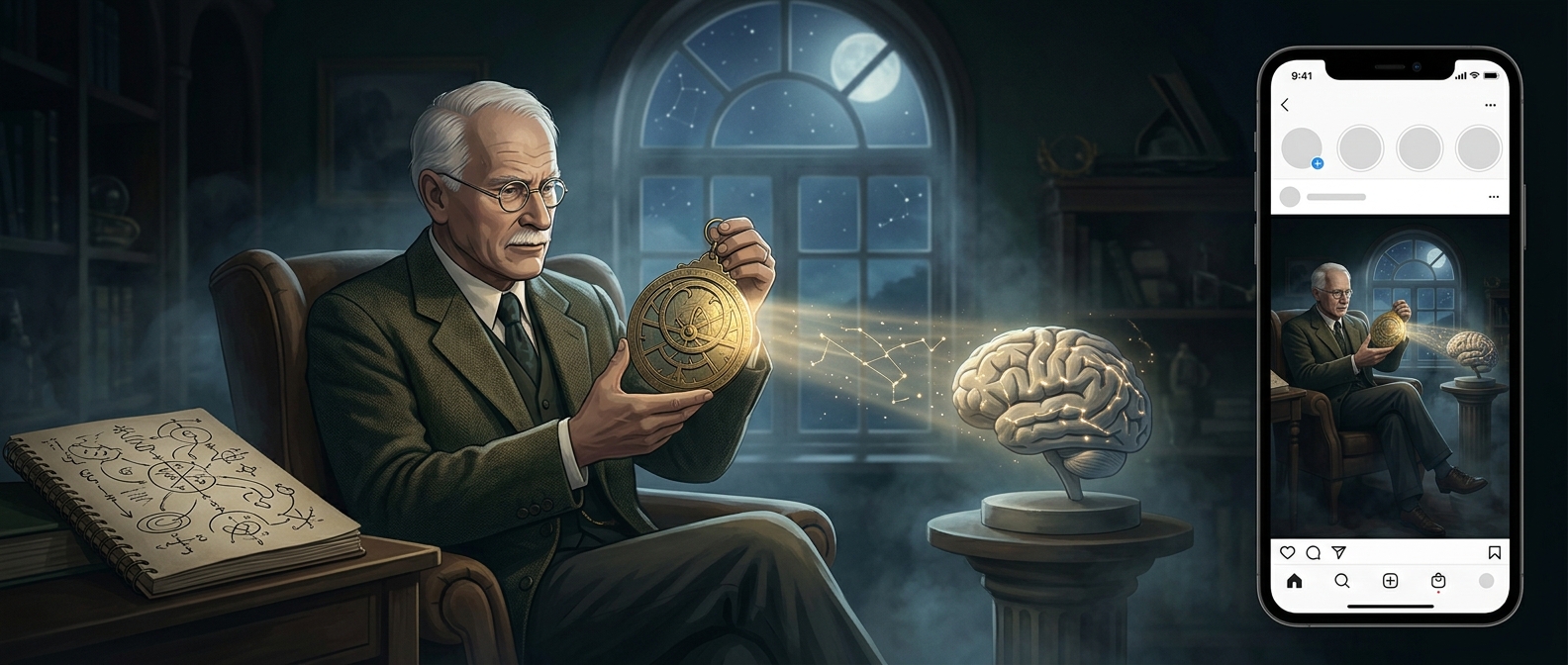
In Jung’s account, Philemon was more than a character he consciously invented. During a period of intense psychological upheaval, Jung practiced active imagination: instead of pushing troubling images away or simply letting them pass, he focused on them and engaged with them as if they could answer. Philemon emerged as a winged, elderly figure, and Jung experienced him as an independent presence who could challenge his assumptions.
That distinction mattered. Jung said Philemon taught him things he had not consciously known. Whether understood as a spirit or as a figure arising from the psyche, Philemon became a way for Jung to encounter thoughts that did not feel like his deliberate, everyday thinking.
From one figure to a theory of the psyche
Jung’s encounter helped shape his interest in the collective unconscious: a proposed layer of the mind that, in his theory, is shared across humanity and expresses itself through recurring symbolic patterns. He did not claim that Philemon alone proved this theory. Rather, the experience gave him a vivid personal example of how mental images could seem autonomous—and how symbolic encounters might reveal material beyond conscious intention.
Philemon also helped Jung develop a method for exploring such material without treating every image as a literal instruction. Active imagination meant staying in conversation with an inner figure: listening, responding, and observing what followed. The practice offered a bridge between spontaneous fantasy and conscious reflection.
Why the story stayed central
Jung recorded these experiences in The Red Book, a richly illustrated record of his confrontation with the images and figures that arose during this period. Philemon became one of its most important presences and a lasting emblem of Jung’s attempt to take the unconscious seriously.
The striking consequence is that a private, uncanny encounter helped furnish both a psychological technique and a central metaphor for Jung’s work: the mind can produce experiences that feel like meeting someone other than oneself.