Jung’s idea of a meaningful coincidence
Carl Jung used synchronicity to describe events that seemed connected by meaning even though neither appeared to cause the other. An astrological configuration and a person’s inner state could, in his view, line up as part of a meaningful pattern without planets exerting a physical influence on the mind.
That distinction mattered to Jung. Psychoanalysis usually looked for causes in a person’s past and unconscious; synchronicity offered a way to discuss experiences that felt significant but did not fit a straightforward chain of cause and effect.
How astrology fit into the picture
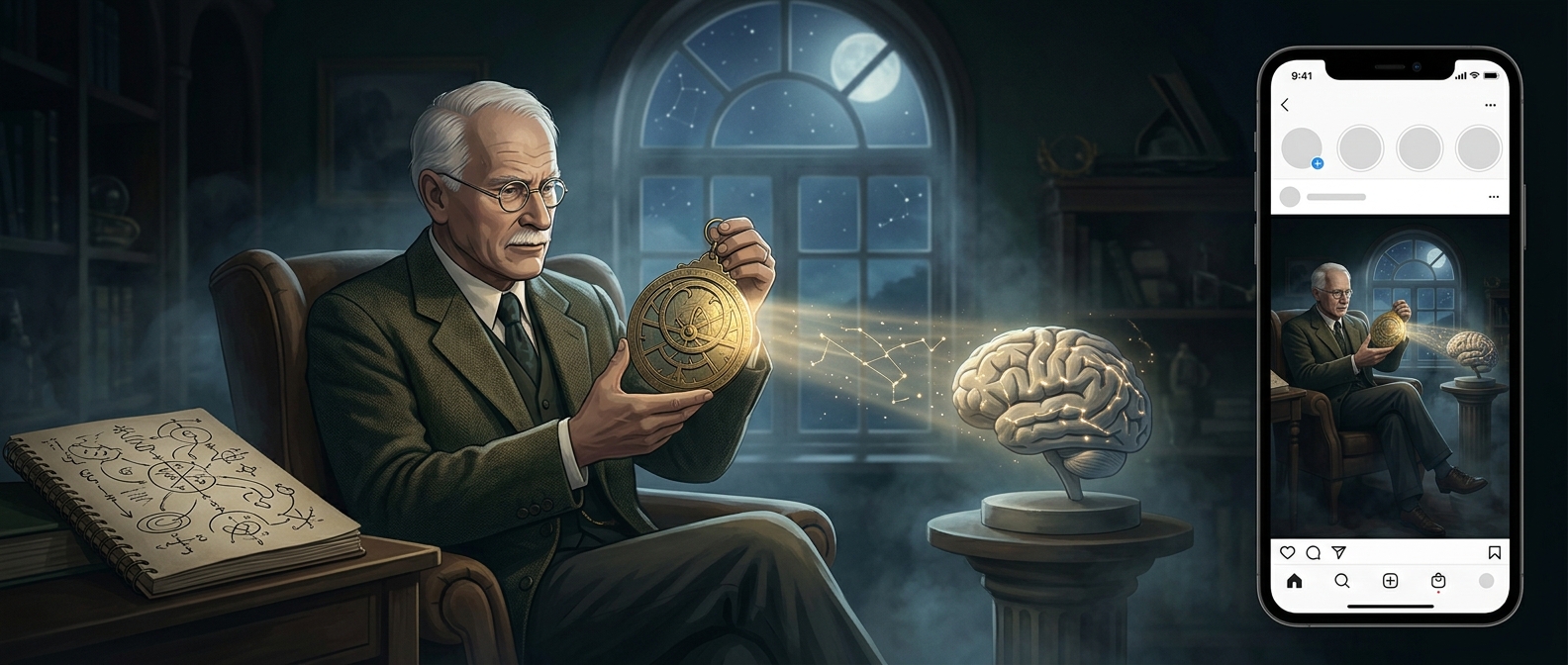
Jung treated astrology as a symbolic language that might reflect psychological patterns. In examining a horoscope, he could look for parallels between its traditional meanings and the concerns or relationships a person was experiencing. The chart, in this approach, was not a demonstrated force shaping someone’s personality; it was a possible framework for interpreting experience.
This made astrology compatible with his idea of synchronicity: the chart and a psychological event might correspond in meaning, rather than one producing the other. Jung’s term gave that proposed connection a name, but it did not establish that the correspondence was real or that astrology could reliably predict events. The concept explains how Jung interpreted such patterns—not evidence that celestial positions cause, or objectively track, a person’s inner life.