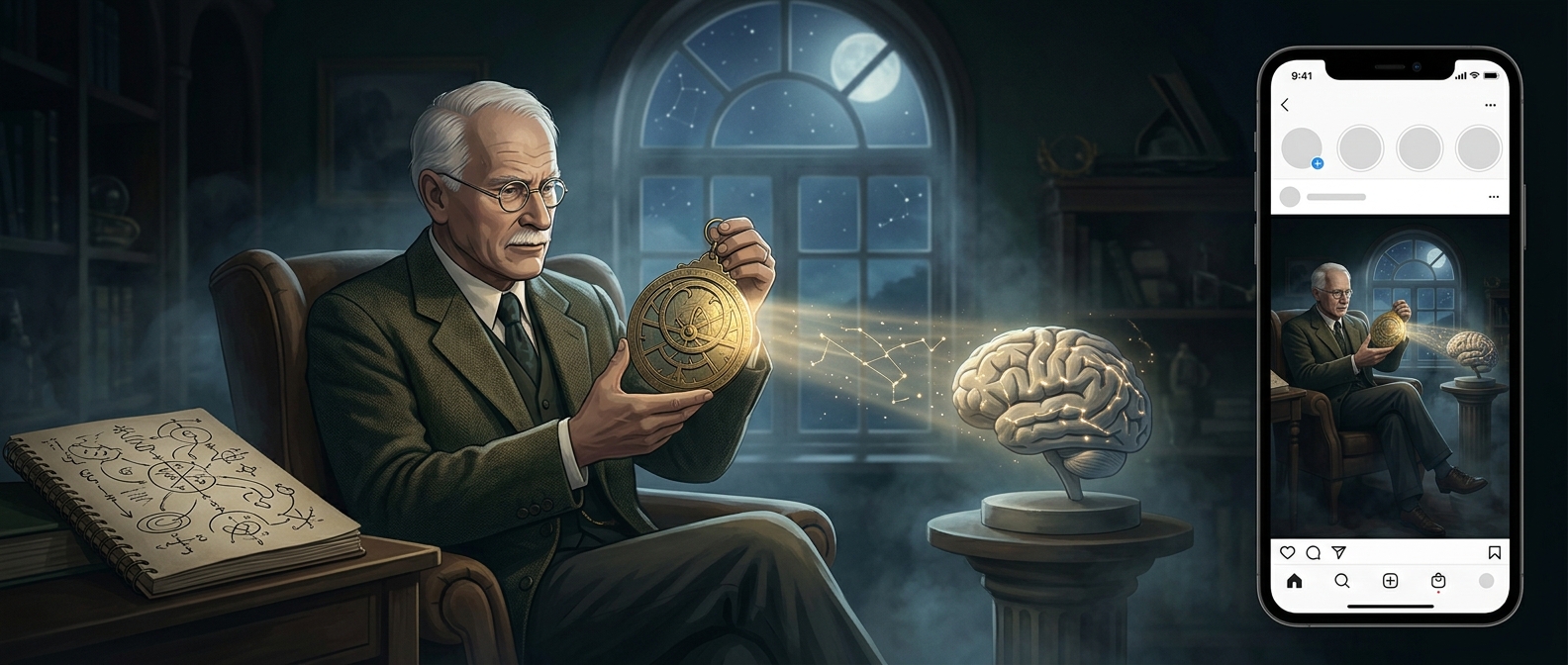
Jung’s idea of a connection without a cause
Carl Jung used synchronicity to describe coincidences that feel meaningfully connected even when no ordinary cause links them. In his view, the significance was not merely that two events happened at once. It was that an outer event seemed to echo a person’s inner thoughts, feelings, or symbols.
That distinction separates synchronicity from a familiar chain of cause and effect. A clock chimes because its mechanism reaches the hour; a coincidence, in Jung’s account, might be a striking event that seems to answer a thought without having been produced by it. He called this an “acausal” connection: meaningful to the person experiencing it, but not explained by one event physically causing the other.
Why Jung thought coincidence could matter
Jung was interested in how symbols and unconscious ideas shape a person’s inner life. He proposed that the psyche—the mind, including processes outside awareness—and the physical world might share an underlying order. On that theory, an unusual coincidence could reveal a pattern linking the two, rather than being only a random occurrence given meaning afterward.
This was a speculative account, not a demonstrated mechanism for consciousness changing physical events. Its lasting appeal lies in the question it raises: why can a coincidence feel like a message? Jung’s answer was that some events might be connected by meaning rather than by a visible chain of causes. The memorable part is also the unresolved one: the experience can feel profoundly personal even when the event itself offers no proof that the universe arranged it.