A face from an occult working
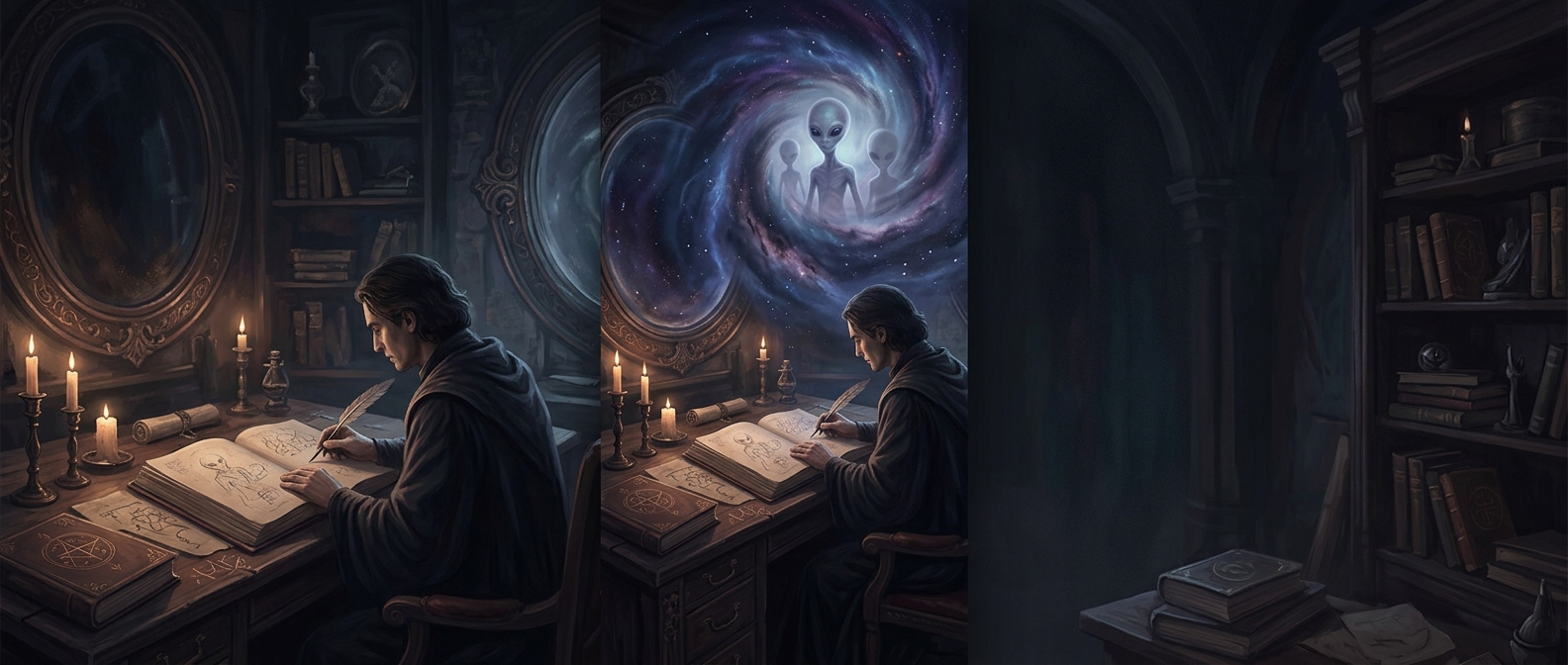
In 1918, Aleister Crowley made a drawing of Lam, an entity he said he had contacted through ritual. The image is spare: a bald, oversized head, a narrow chin, and dark, prominent eyes. Crowley interpreted Lam as a being from beyond ordinary human experience—not as a creature from another planet in the modern scientific sense.
That distinction matters. “Trans-dimensional” belongs here to occult belief: the idea that a being might inhabit or cross a level of reality beyond the everyday world. The drawing records Crowley’s interpretation of an experience, not independent evidence that such a being existed.
A resemblance, not a proven origin
Lam’s face is often compared with the “Grey” alien that became familiar in later popular culture: a small, smooth head with large dark eyes. The resemblance is striking because Crowley’s sketch predates the Grey’s later prominence in science fiction and UFO imagery.
But an earlier image is not automatically the source of a later one. Without evidence connecting Crowley’s drawing to the artists and stories that shaped the Grey, it is safer to treat Lam as an intriguing predecessor in appearance, not the confirmed blueprint for the pop-culture alien. The drawing’s lasting hook is precisely that gap: it looks uncannily familiar, while its original meaning came from a very different world of ritual and occult interpretation.