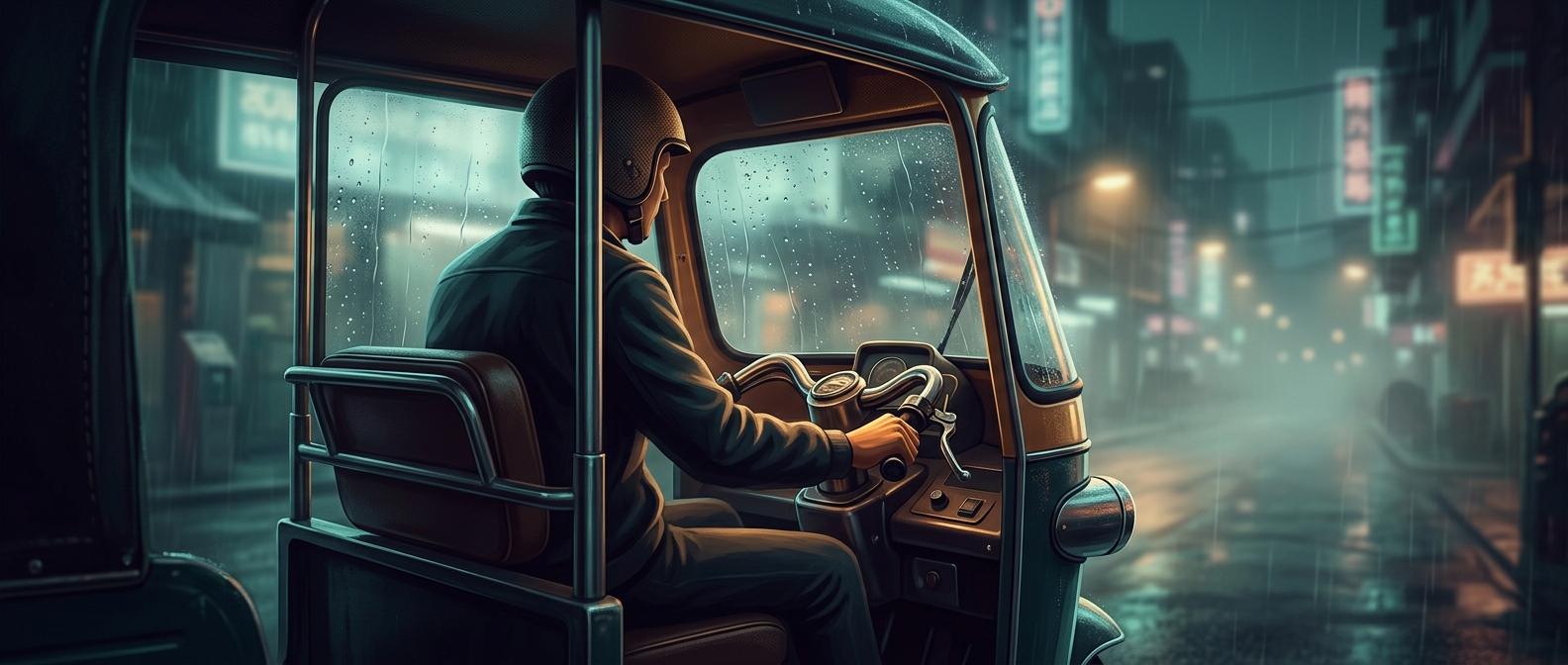
A Handlebar Inside a Cabin
In a handlebar-steered tuk-tuk, the driver turns the front wheel much as a motorcyclist does. The handlebars are attached to a steering column, which carries the movement down to the wheel assembly. Turn the bars left, and the front wheel changes direction; the powered rear wheels continue pushing the vehicle along its new path.
That arrangement keeps the steering action direct: the driver’s hands control the wheel’s angle rather than turning a car-style steering wheel linked to a set of steering arms. The body may look like a tiny enclosed room, but its basic steering input remains familiar to someone accustomed to a two-wheeler.
The Cabin Changes the View, Not the Control
A roof and side panels give the driver shelter, yet they also make the vehicle feel more like a small cabin than an open motorcycle. The handlebars sit within that enclosure, so the driver steers with arm movements while looking out from behind the bodywork. The wheel that responds is still at the front, not beneath the driver’s hands.
This layout is a reminder that a vehicle’s shape and its steering method are separate design choices. Enclosing the driver does not, by itself, require car-style controls. In a tuk-tuk built this way, a cabin has formed around a control system that still works like a two-wheeler’s: the driver turns the bars, and the front wheel turns with them.