Why an alpha particle runs out of road
An alpha particle is a compact, positively charged bundle of two protons and two neutrons—the same basic arrangement as a helium nucleus. As it moves through matter, its electric charge tugs on electrons in nearby atoms, knocking some loose. These collisions, called ionization, drain the particle’s energy quickly. Rather than slipping through layers of material, an alpha particle leaves a dense trail of disruption over a very short distance.
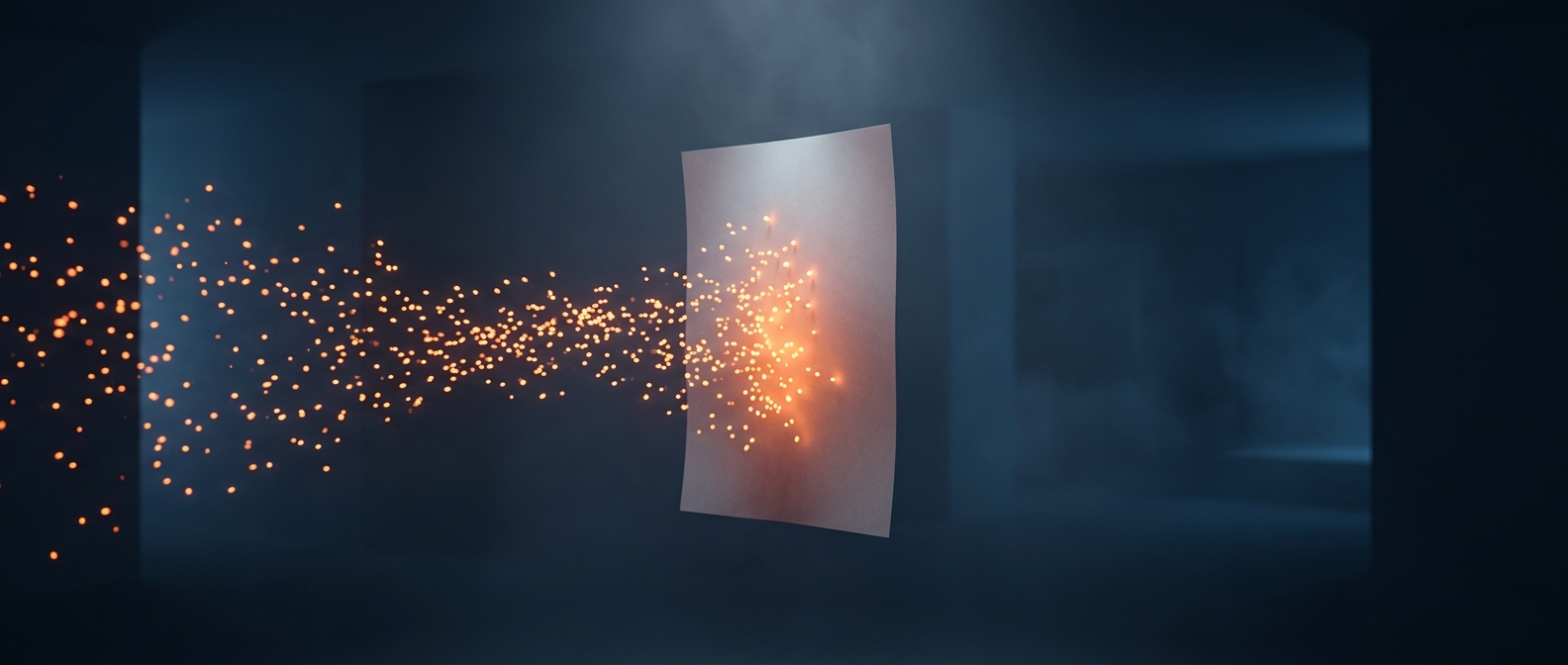
A sheet of paper contains enough atoms for that trail to end. The particle is absorbed, and its energy is deposited in the paper instead of traveling onward. The same short range is why alpha radiation poses little danger from outside the body: the outer dead layer of skin generally stops it before it reaches living tissue.
The barrier depends on where the source is
That protection changes if alpha-emitting material is breathed in, swallowed, or otherwise gets inside the body. There, the particles can travel through nearby living cells and deposit their energy in a small region. The key difference is not that the radiation becomes more powerful, but that the tissue is now in its path and the usual outer barrier is gone.
This is why alpha radiation calls for a different kind of protection than a highly penetrating radiation: a thin barrier can stop the particles, but preventing radioactive material from entering the body matters too. A page of paper can halt an alpha particle; it cannot protect tissue that has become the particle’s immediate surroundings.