Why a train cannot stop as one solid object
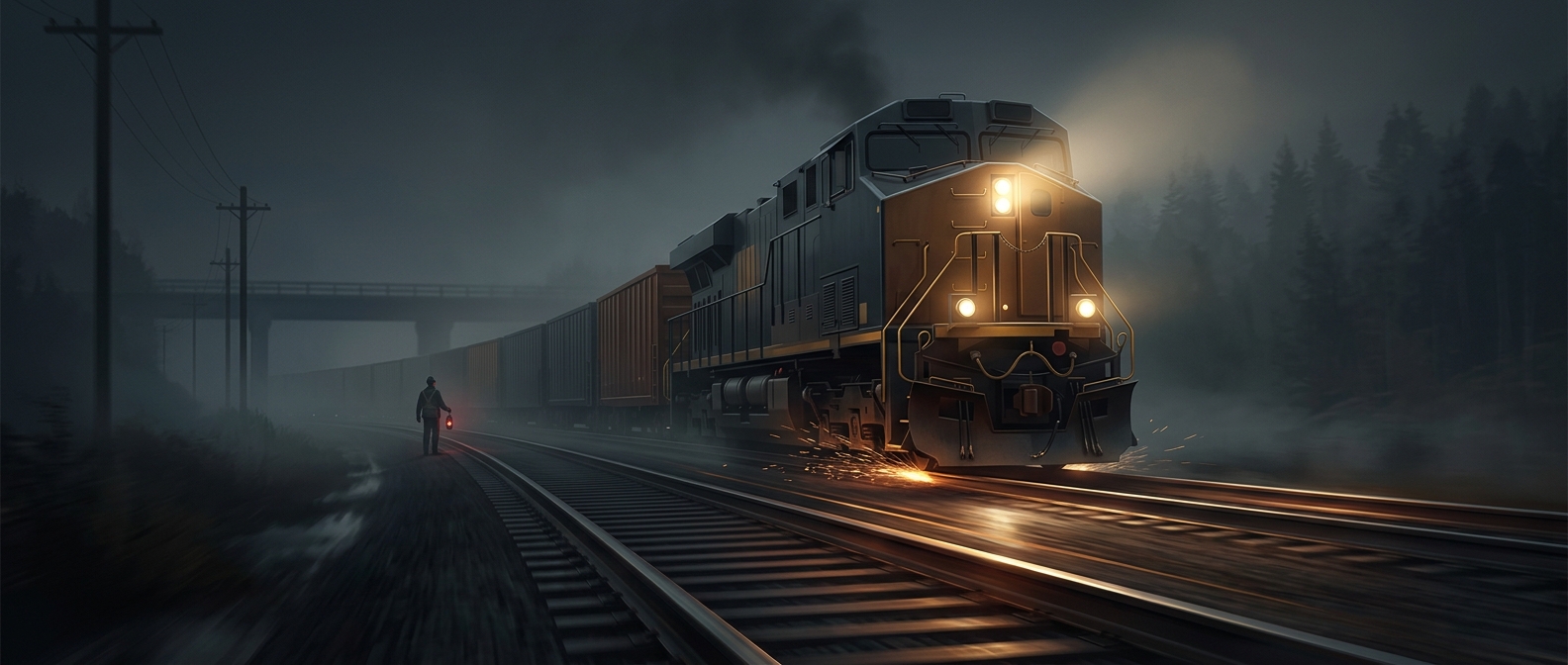
A freight train is a chain of separately moving cars, not a single vehicle with one set of brakes. The locomotive’s engineer controls an air-brake system that runs along the train: changing pressure in the brake pipe tells the cars’ brakes to apply. That signal takes time to travel, so cars do not all begin braking at exactly the same moment. The brakes then press shoes or pads against wheels or discs, turning some of the train’s motion into heat.
A long train has momentum at both ends
When the cars begin to slow, their couplers—the links between cars—also transmit forces down the line. Cars can compress together as braking takes hold, then pull against one another as the forces shift. That movement, known as slack, is one reason braking must be managed carefully: abrupt changes can strain equipment or destabilize a train, especially on curves or uneven track.
The distance needed depends on more than the train’s length. Speed matters enormously: at higher speeds, there is more motion to dissipate. The weight and arrangement of the cars, the track’s slope, and the condition of the wheels and brakes all affect how quickly the train can slow. Wet, icy, or otherwise poor rail conditions can further limit the grip available.
Why the warning distance matters
A mile-long stopping distance is not a fixed rule for every freight train, but it conveys the scale of the problem. A locomotive crew must anticipate signals and obstacles far ahead; by the time a hazard is visible, braking may already need to be underway. That is why a train cannot swerve around a vehicle on the tracks, and why a road crossing must be treated as a place to clear before a train arrives—not as a place where it can stop on demand.