Why a Turning Screw Can Move Water Uphill
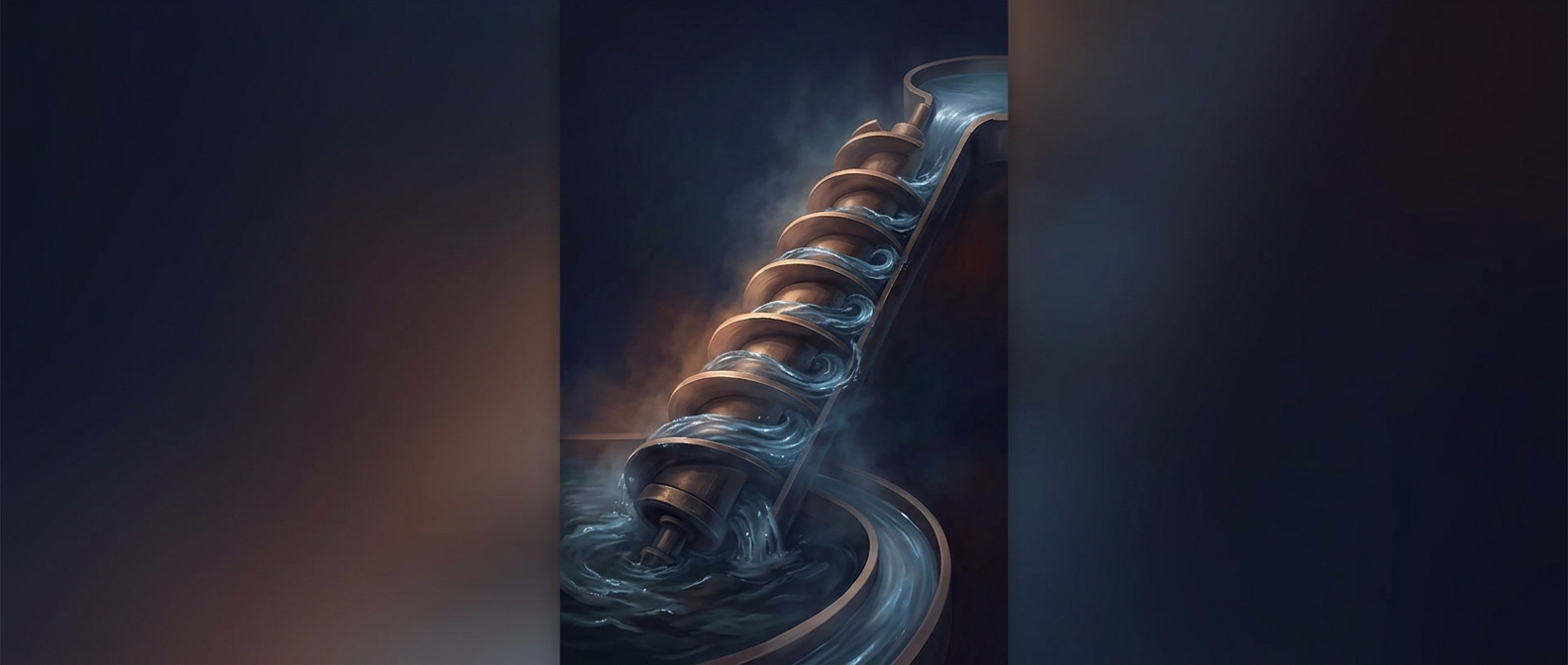
The screw works because its spiral partitions a sloping channel into a series of moving compartments. As the shaft turns, each compartment changes position: water enters at the low end, is carried along the channel, and spills out at the higher end. The screw does not need to form a watertight seal. A little water can slip backward through the gaps, but continued rotation keeps pushing more water forward.
The angle matters. Set the screw too steeply, and water is more likely to run back before reaching the outlet. A gentler slope lets the compartments hold water more effectively, though it takes a longer screw and more room to reach the same height. The design trades compactness for a steady lift.
A Lift Suited to Flow, Not Pressure
Unlike a pump that forces water through a narrow pipe, a screw elevator moves open volumes of water. That makes it useful when water contains grit or debris that could obstruct smaller passages. The screw can also raise a substantial flow through a modest vertical distance without requiring the water to be sealed inside a pressurized system.
The same geometry can work in reverse: falling water can turn the screw and drive a generator. In either direction, its advantage is not a dramatic leap upward but a controlled sequence of small lifts. Each rotation advances the water one compartment at a time.