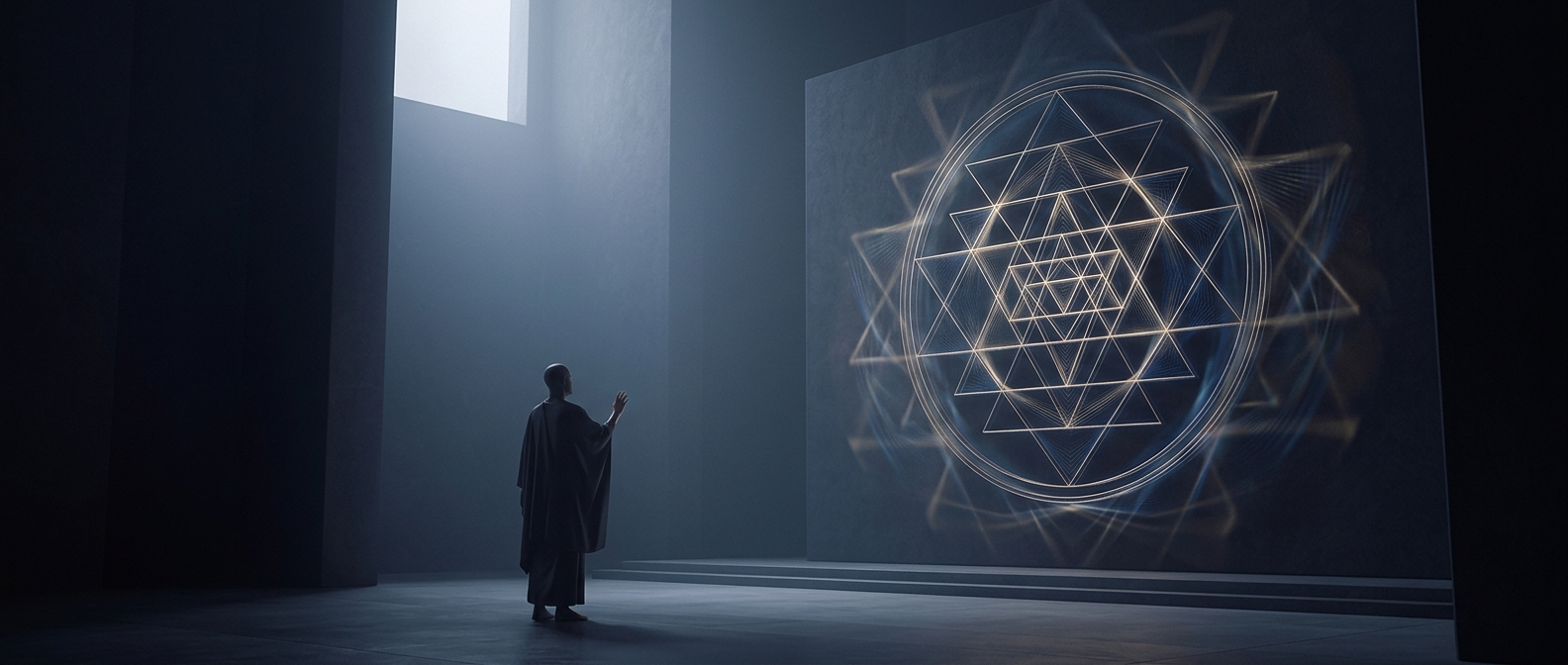
Why the lines can seem to move
A Sri Yantra is built from interlocking triangles arranged around a central point. Their sharp edges and repeated crossings pack many boundaries into a small area. When someone studies the pattern closely, the visual system has to keep sorting those edges and deciding which shapes belong together. Dense, high-contrast detail can make that work harder, so parts of the design may seem to shimmer, shift, or blur—especially during prolonged, steady viewing.
The eyes also make tiny movements even when a person tries to hold a gaze still. As those movements carry the pattern across the retina, repeated lines can produce unstable impressions. These are ordinary features of visual perception, not a special property unique to the yantra.
Why the experience can feel significant
The yantra is not only a geometric image; it has a role in Hindu spiritual practice. For practitioners, concentrating on its nested forms can be a way to direct attention inward. If the design begins to look unstable, that sensation may become part of a meaningful contemplative experience, interpreted through the person’s beliefs and practice.
That distinction matters: the visual effect can have a familiar perceptual explanation while still carrying spiritual meaning for the viewer. A change in what the eyes seem to see does not, by itself, establish a change in consciousness—but the setting and interpretation can shape what the experience means.