What Stoics Meant by Sympatheia
The Stoic idea of sympatheia—literally, “having a fellow-feeling”—described the universe as a connected whole. Its parts were not isolated objects: each belonged to a larger order and could be understood only in relation to it. The word’s emotional overtones can be misleading, though. Stoics were not saying that planets literally feel affection or distress for one another.
A Cosmos Held Together by Nature
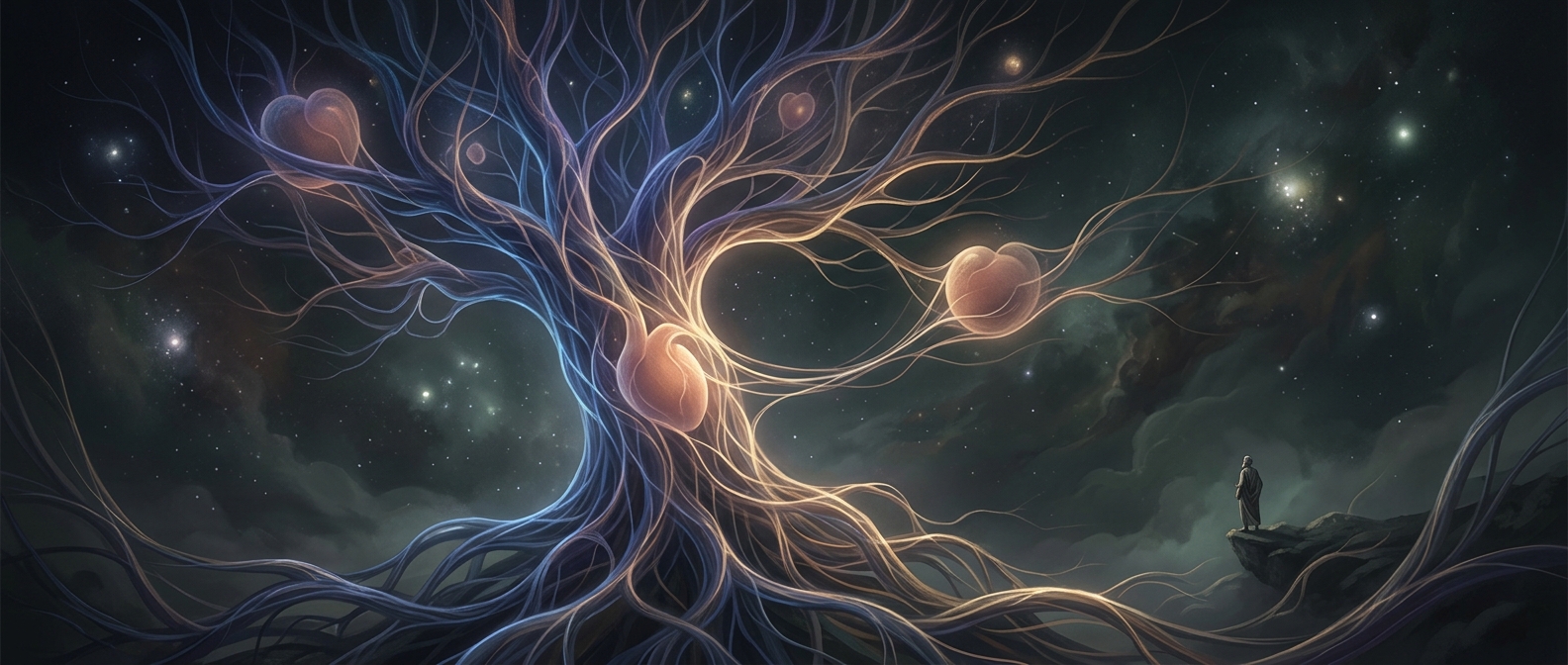
Stoics pictured the world as an organized, living system, permeated by pneuma: a breathlike principle that, in their philosophy, gave things cohesion and structure. Because the same ordering principle ran through the cosmos, distant events could be linked rather than merely coincidental. The image is closer to a body whose parts participate in one life than to a collection of unrelated pieces.
That view also shaped how Stoics thought about knowledge. A change in one part of a system could provide clues about the whole, and human reason was itself a small expression of the rational order they believed governed nature. The cosmos was therefore not just scenery surrounding human life; people belonged to it and were implicated in its unfolding.
Connection Without Cosmic Emotion
Calling the universe “emotionally codependent” makes sympatheia sound like a claim about shared feelings. The Stoic point was broader and more structural: everything belongs to an interconnected natural order, so nothing is wholly separate from the whole. That did not mean every event was personally directed at an individual. It meant that understanding any event required seeing it within the larger web of causes and relationships.
The idea gave Stoic reflection a practical consequence: when circumstances changed, the question was not only what had happened to “me,” but how this event fit into a world no person could stand apart from.