A pool has its own rhythm
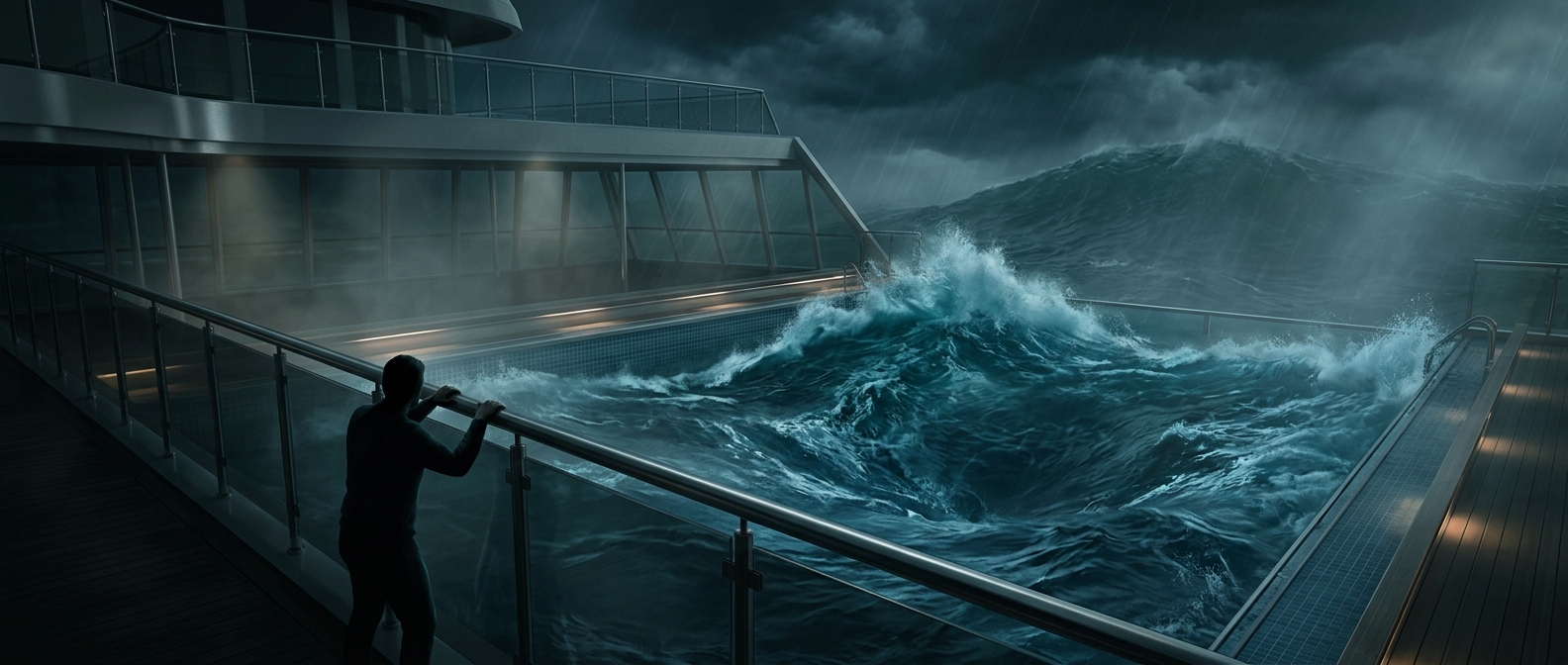
A cruise ship can roll gently while the water inside its pool moves with a different rhythm. Water has inertia: when the deck shifts, the water does not instantly follow, so it surges toward one side. As the ship rocks back, the water may still be moving in the original direction.
That back-and-forth motion is called sloshing. Every pool has a natural sloshing rhythm set partly by its length and depth. If the ship’s motion repeatedly nudges the water at a rhythm close to that one, each surge can reinforce the next—much like pushing a swing at just the right moment. The ship need not be in a dramatic storm for the movement to become conspicuous.
Why the water can reach the deck
In a broad, open pool, there are few internal barriers to interrupt the water’s travel. Stabilizing baffles—partitions that break up a moving body of water—can reduce sloshing in some tanks, but a passenger pool must remain open for swimming. With little to slow the surge, water can cross the pool, climb its edge, and spill onto the surrounding deck.
The shallow water around a pool does not need a huge wave to look dramatic: a surge that is small relative to the pool can still sweep across a wide surface. The result is a visible reminder that the pool is moving with a ship, while its water is briefly following its own momentum.