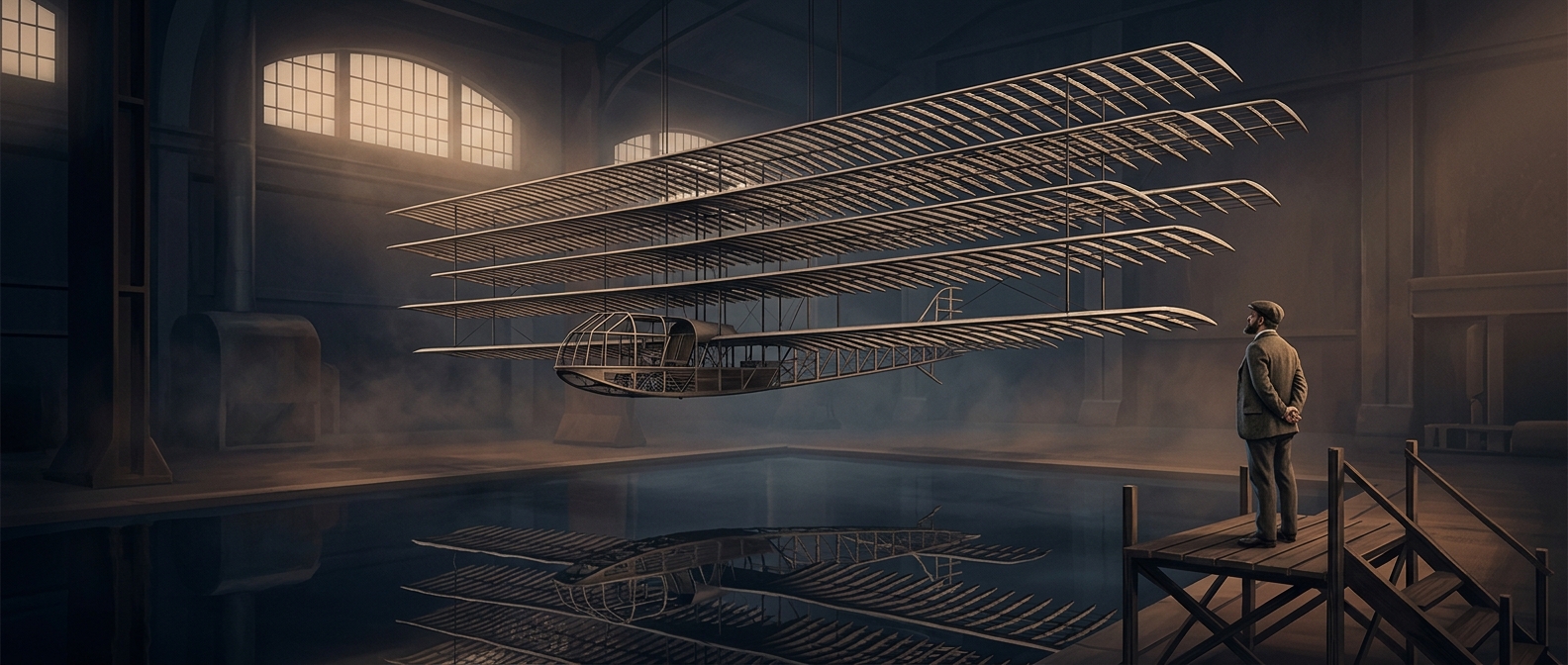
Why Phillips stacked so many wings
A wing produces lift by redirecting air downward; the resulting force pushes the aircraft upward. In principle, adding wing surface can increase that force without making the airplane’s overall span much wider. Horatio Phillips pursued that idea by arranging roughly 200 slim lifting surfaces in a stack, turning a compact structure into a great deal of wing area.
The design treated wing area as something that could be built upward, not just outward. That mattered for an experimental aircraft whose ability to rise was the first problem to solve: Phillips’s machine did lift, showing that the layered arrangement could generate enough upward force to leave the ground.
More surface brought more complications
But a stack of wings is not simply one large wing divided into convenient strips. Each surface moves through air already disturbed by the ones above and below it. The close spacing can make the surfaces interfere with one another, while every extra wing also needs supports and connections. Those parts add weight and create drag—the air resistance that opposes forward motion.
So the same construction that supplied abundant lifting area also made the machine structurally elaborate and aerodynamically awkward. Its many narrow planes could help it get airborne, but they did not make the overall aircraft simple or efficient. The striking lesson is that adding more wing can solve one engineering problem while multiplying several others: Phillips’s machine rose, but its forest of surfaces made clear how costly that solution could be.