The rotor’s hidden tug-of-war
A helicopter’s main rotor does more than push air downward. As the engine spins the rotor one way, the rotor pushes back on the aircraft body in the opposite direction. This reaction torque would make the fuselage yaw—turn around its vertical axis—unless the design found a way to counter it.
That problem was especially unforgiving in early machines. Their engines and rotor systems were heavy, and engineers had less experience predicting how flexible frames and fast-spinning blades would behave. A helicopter could not simply borrow an airplane’s solution of moving forward: it had to control both lift and unwanted rotation while hovering.
More rotors, more machinery
One answer was to use additional lifting rotors. Two rotors turning in opposite directions can cancel much of each other’s torque, so the body does not need to fight the full twisting force. Designers tried arrangements that placed rotors side by side, one above the other, or at opposite ends of the aircraft.
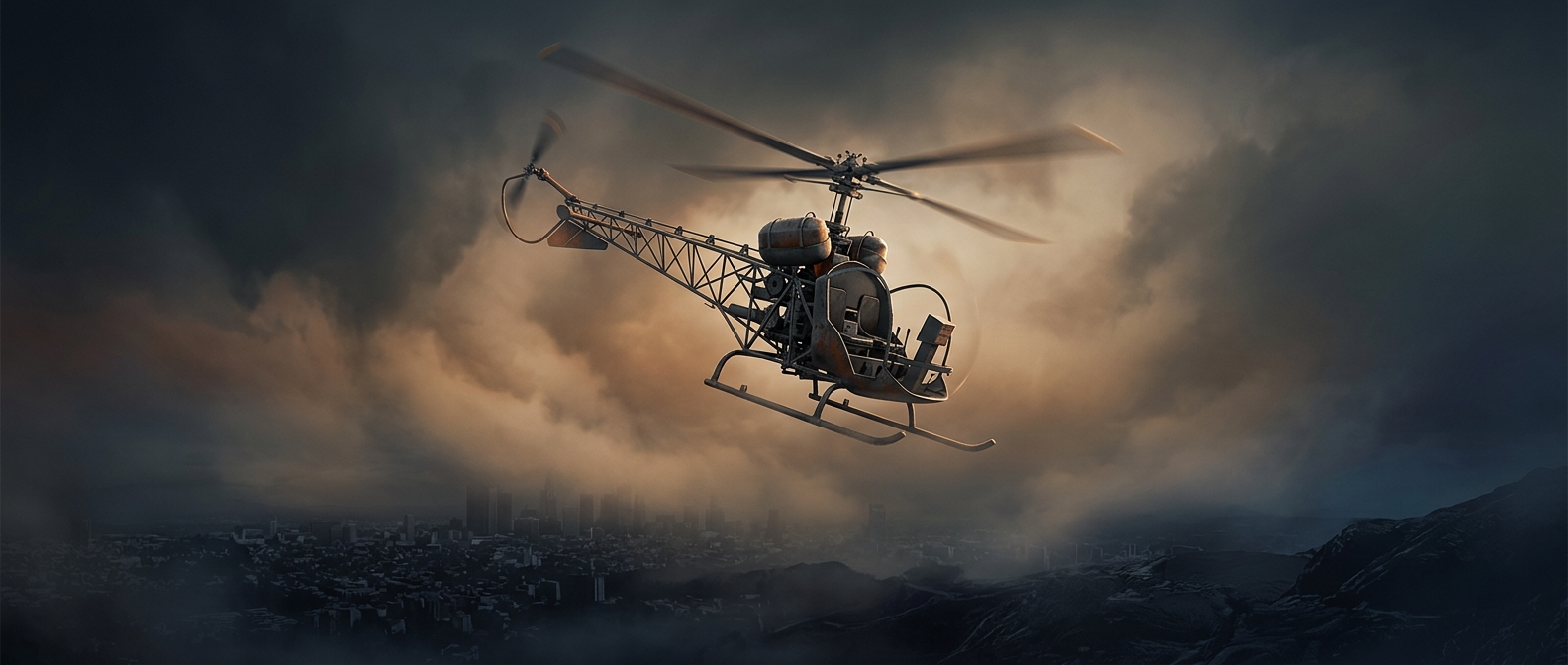
Those layouts solved one problem by adding others. Multiple rotor heads, shafts, gears, and supporting frames meant more parts to build, align, and maintain. Intermeshing blades—rotors whose paths overlap but are timed to miss each other—also demanded precise coordination. The visible scaffolding was not decoration; it held the machinery in position and kept moving parts clear of one another.
Why the blades stayed exposed
A later common solution used a small tail rotor to push sideways against the main rotor’s torque. That reduced the need for a second large lifting system, but it added another exposed rotor and its own control demands. In any layout, the main blades had to sweep through open air to generate lift; enclosing them in a protective shell would interfere with that airflow and add weight.
The unsettling appearance therefore reflected real engineering tradeoffs: every added mechanism helped control the aircraft, but also made it more intricate. A helicopter’s stability depends on those forces being balanced continuously—not just on getting it off the ground.