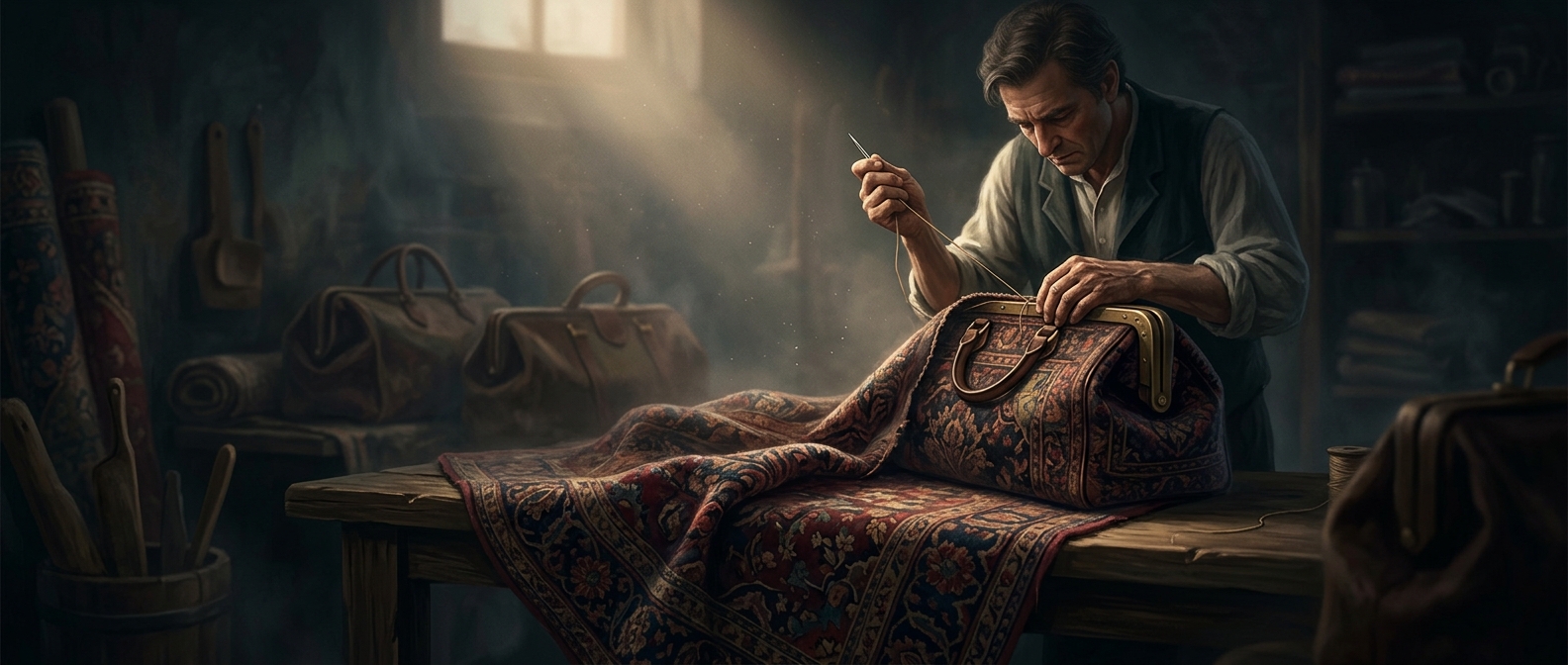
Why a rug could become a travel bag
A rug is built to take repeated friction underfoot. Its dense backing and tightly packed fibers resist scuffing and tearing better than many thin woven fabrics, making worn carpet a practical source of material for luggage. Once a rug had faded or frayed in the middle, its less-damaged sections could still serve as broad, sturdy panels.
Strength came with a tradeoff
Turning those panels into a bag meant cutting and joining a material designed to lie flat. The seams and handles—not the rug’s surface—would bear much of the strain when a traveler lifted a packed bag. Thick fabric could help protect what was inside, but it also made the luggage heavier and less pliable than a cloth case. Reuse made sense when toughness mattered more than lightness or a neat, uniform appearance.
Travel gear made from what was at hand
This kind of luggage reflects a practical approach to travel: useful material did not have to begin as luggage. A rug too worn for a room could still have years of service in a new form. The result was baggage with a texture and pattern usually associated with a parlor floor—and with enough heft to make its recycled origins hard to miss.