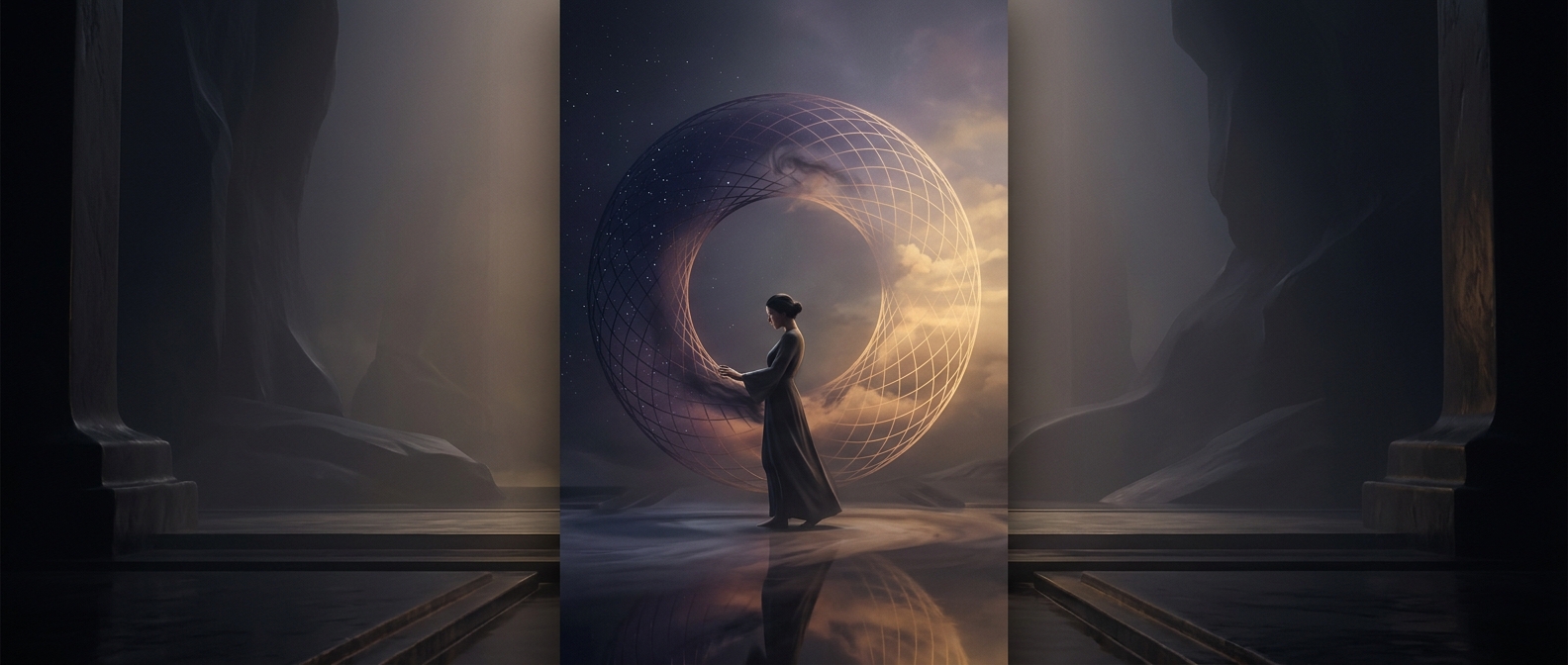
A scale instead of two separate things
In Hermetic philosophy, polarity is a way of interpreting contrasts: the poles are not wholly unrelated forces, but ends of a shared scale. Heat offers an everyday model. “Hot” and “cold” name different degrees of temperature, and between them lie many gradations. The contrast remains useful, but it need not imply two fundamentally separate kinds of reality.
This is a philosophical lens, not a claim that every pair of opposites can be measured like temperature. Its point is to ask whether an apparent division might conceal continuity. A sharp boundary in ordinary language can make two conditions seem absolute even when we can imagine intermediate states.
Why the distinction matters
The idea changes how a person might approach a conflict or a change in feeling. If two states are understood as points along a continuum, the question becomes not only “Which side is this?” but also “How far has it shifted, and what might move it?” That framing favors degrees and transitions over an all-or-nothing judgment.
It does not make opposites identical or erase meaningful differences. Rather, it treats the difference as one of degree within a larger relationship. The memorable implication is that a boundary can be real in experience without being an absolute divide.