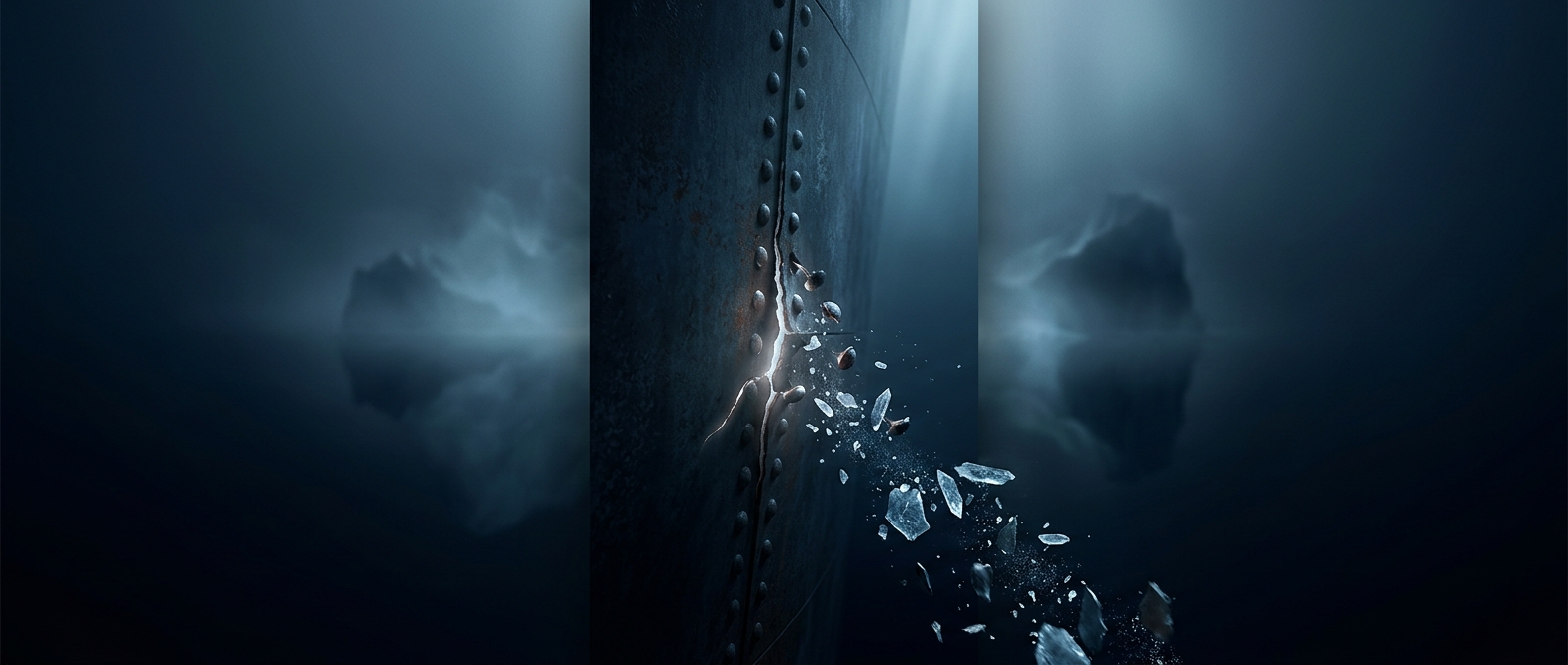
Why a rivet could fail before a hull plate
A rivet is not just a pin through two pieces of metal. Its head clamps the plates together, helping them act as one structure and resist forces that try to slide or pull them apart. In a collision, the hull could flex and the joints around the impact could be hit by sudden, repeated loads.
Ductile iron can deform before it breaks, absorbing some energy. Brittle iron gives less warning: instead of stretching or bending much, it can crack under a sharp shock. Once a rivet fractured or worked loose, the joint could open and let neighboring plates shift, making the damage larger than the failed fastener itself.
Material and temperature mattered
The Titanic’s hull plates were joined with a mix of steel and wrought-iron rivets. Wrought iron contains small strands of slag—nonmetallic residue from its production. Their amount and distribution affect the metal’s strength and toughness. Analyses of recovered rivets have pointed to material weaknesses, but no single factor explains every failure.
Cold conditions also matter to some metals: at low temperatures, they can become less able to absorb impact energy before breaking. That does not mean the rivets simply turned brittle because the water was cold; their composition, how they were made and installed, and the force of the collision all shaped how the joints behaved.
A small failure with a large consequence
The hull was built from many overlapping plates, so damage did not require one enormous tear. If fasteners failed along a joint, water could pass through the resulting openings, and the ship’s watertight compartments could be compromised in sequence. The rivets were not the whole explanation for the sinking, but they illustrate a crucial engineering point: a structure is only as resilient as the connections that let its parts share a sudden load.