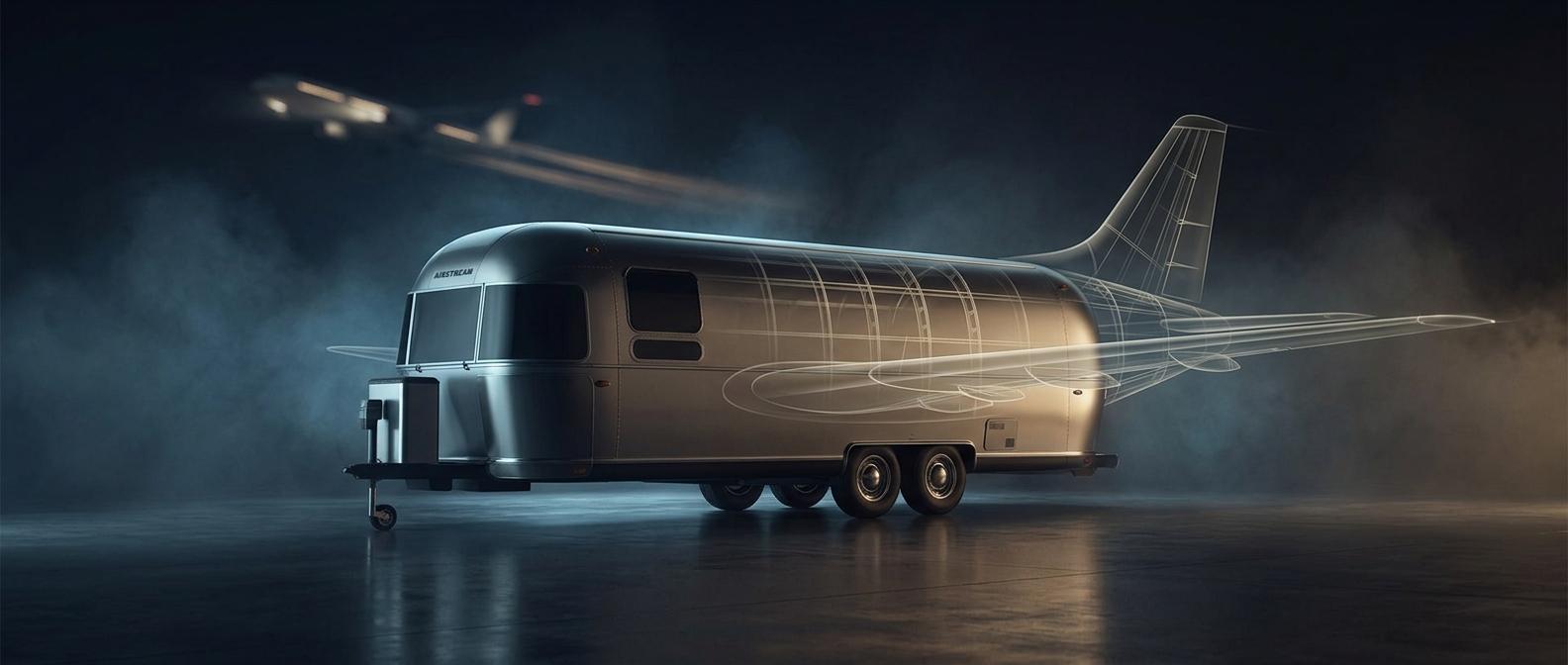
An airplane’s answer to a road problem
Airstream’s silver shape grew out of a practical challenge: a trailer has to move a large, enclosed space through the air while a car pulls it. A boxy body pushes air aside abruptly, creating drag—the resisting force that makes towing harder and can increase fuel use. Streamlined curves let air flow around the trailer more smoothly.
The airplane connection was more than a visual reference. Aircraft builders had learned to make strong structures from aluminum without carrying unnecessary weight. For a trailer, that mattered too: lighter construction is easier for a tow vehicle to pull, while a sturdy shell must withstand vibration and changing road conditions.
A shell built from shaped panels
Airstream’s body is assembled from curved aluminum panels fastened together over a supporting frame. The rounded front and roof guide air over the body rather than confronting it with a broad, flat face. The metal’s shine comes from the material itself, so the exterior does not need paint to create its characteristic silver appearance.
Those choices work together. The curves address airflow; the aluminum helps keep the structure relatively light; and the joined panels form the recognizable shell. It is not an airplane fuselage on wheels, but it borrows a related design logic: shape the exterior to manage air, and use lightweight metal to build a durable body.
The tradeoff behind the silhouette
Streamlining cannot eliminate the extra work of towing a large trailer, and a rounded shell still has to make room for people, furniture, and storage. The design is therefore a compromise between useful interior space, strength, weight, and airflow. Its enduring airplane-like look is a visible trace of that engineering problem: even when parked, the trailer’s curves suggest the air it was shaped to move through.