How rock becomes dissolved salt
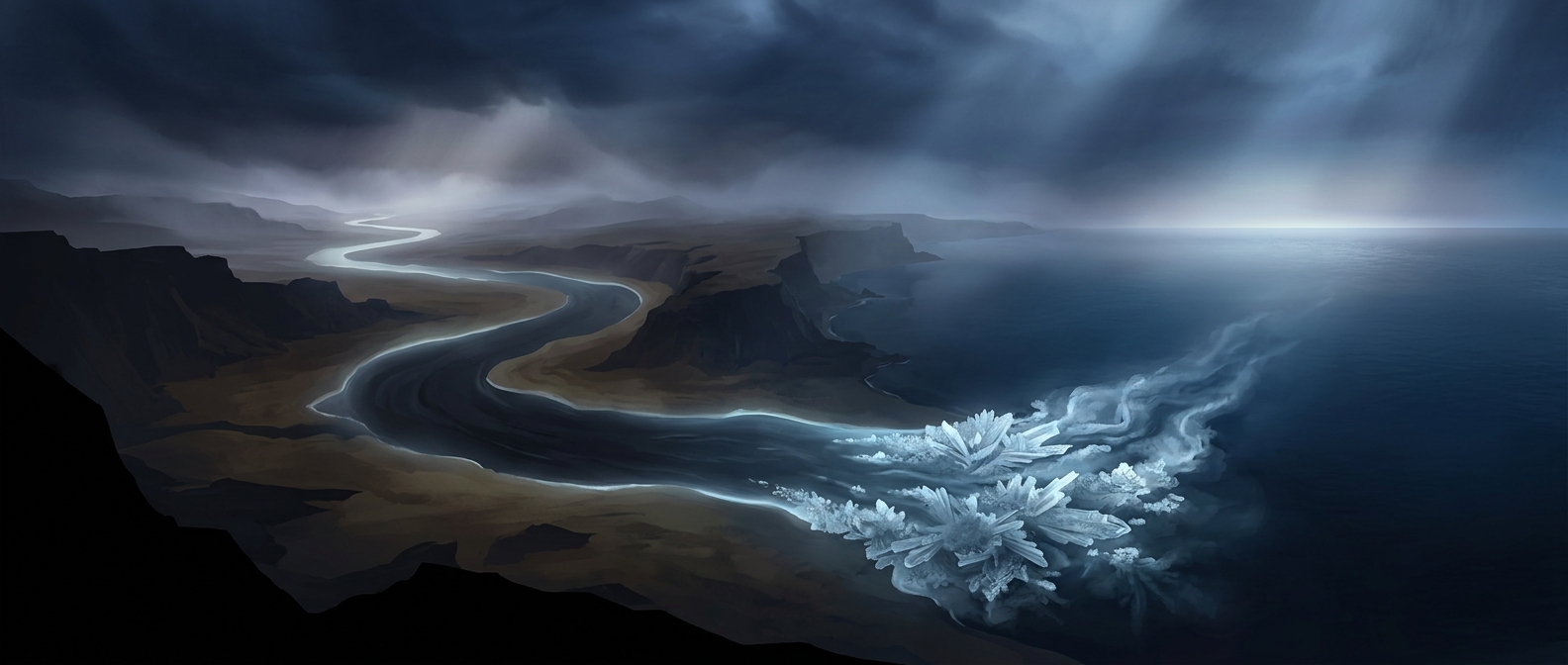
Rain begins the process by absorbing carbon dioxide from the air and soil, making it mildly acidic. As it seeps through ground or runs over exposed stone, it reacts with minerals and breaks some of them into dissolved ions—charged particles too small to see. Rivers carry those particles downhill, often alongside fine grains of eroded rock.
The dissolved load is not just table salt. It includes sodium and chloride, the main ingredients of seawater’s familiar saltiness, as well as calcium, magnesium, potassium, and other substances. Different rocks and soils contribute different mixtures.
Why the ocean keeps the minerals
When seawater evaporates, water molecules escape into the air, but most dissolved ions do not. They remain in the water left behind, becoming more concentrated. That is why evaporation can make salty water saltier, and why water evaporated from the ocean later falls as rain with very little salt in it.
Rivers continually bring fresh dissolved material to the sea. But ocean salt does not simply build up without limit: some dissolved substances are taken up by marine organisms, locked into minerals, or buried in seafloor sediments. Others are exchanged between seawater and the ocean floor. Over long periods, these inputs and removals help shape seawater’s composition.
The striking part is the separation: the water can cycle back to land and sky, while many of the minerals delivered by rivers remain in the ocean. Each raindrop helps move rock’s ingredients toward the sea, even though the journey from stone to seawater may take an immense amount of time.