Why a tsunami travels differently from an ordinary wave
A tsunami is not a steep, rolling crest like a wind-driven wave. It is a long pulse of moving water, often with a wavelength—the distance from one crest to the next—so large that the ocean floor influences it even in deep water. That makes it a shallow-water wave in the physics sense, although the water above it may be thousands of feet deep.
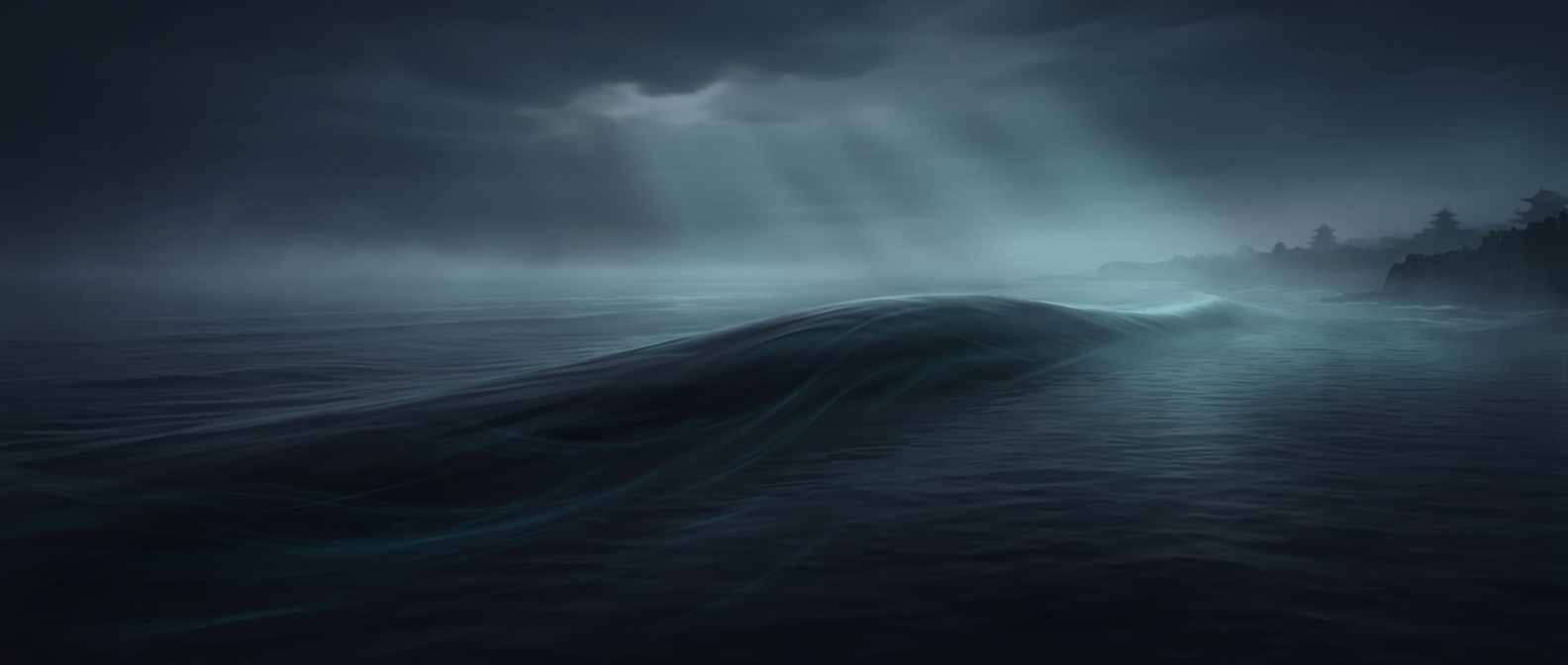
Its speed depends mainly on water depth: the deeper the water, the faster the wave travels. But its enormous length spreads the disturbance across such a broad stretch of ocean that the surface may rise only modestly. A ship can therefore ride over the passing swell without encountering a dramatic wall of water.
How the coast turns the pulse into a hazard
As the seabed rises toward shore, the tsunami slows. The water behind it continues moving forward, and the wave’s length shortens. The disturbance is compressed into shallower water, making the surface rise and the flow grow stronger. This process, called shoaling, helps explain why a tsunami that was inconspicuous offshore can produce destructive flooding on land.
The change is not simply a neat crest growing taller. A tsunami may arrive as a fast-rising surge, a series of surges, or a powerful current; local coastlines and seafloor shapes influence what happens. And because the waves can be separated by long intervals, the first surge is not necessarily the largest. The quiet passage over open water is therefore no sign that the energy has vanished—it is still traveling, poised to interact with the rising seabed.