How an arch turns weight into a sideways push
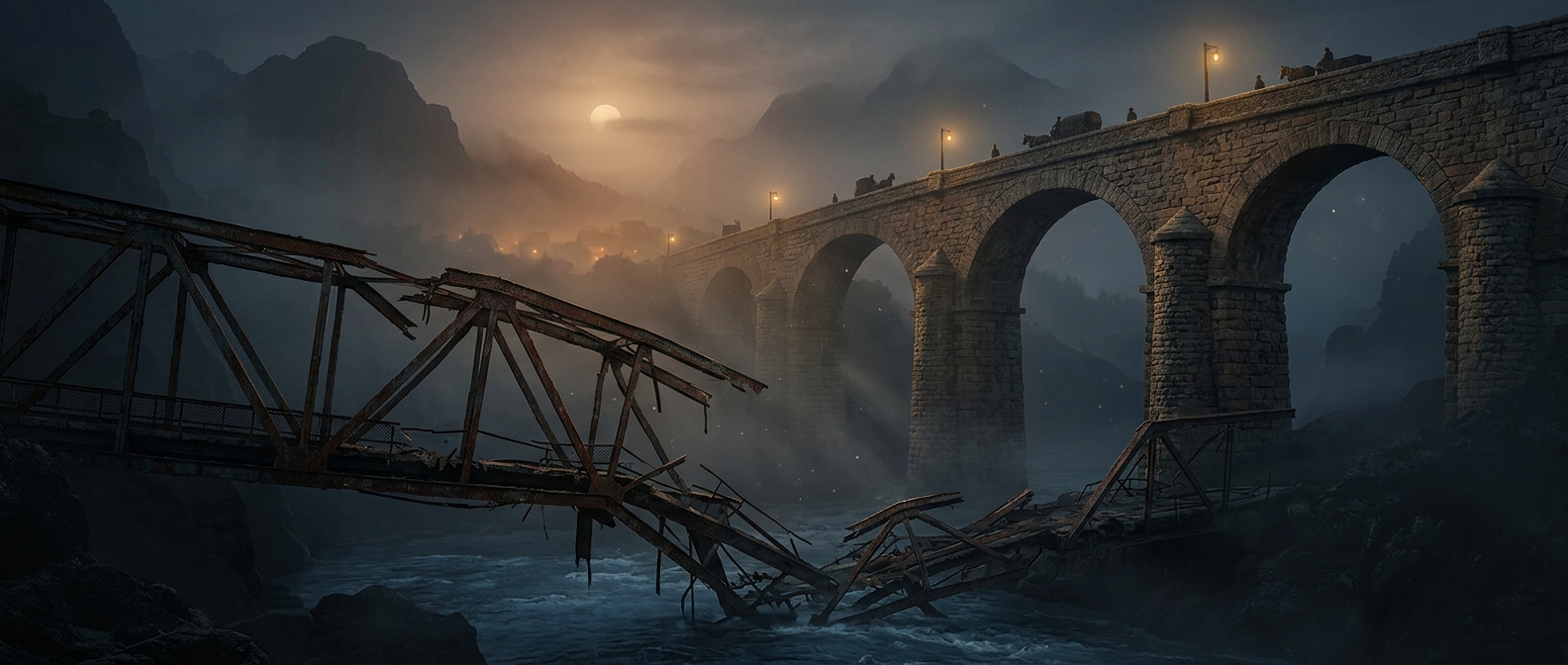
A stone arch stays up because its curved shape redirects the load. A person, cart, or roadway presses down on the arch; each wedge-shaped stone, or voussoir, transfers that pressure to its neighbors. The stones are squeezed together, and the force travels down and outward toward the banks.
At the crown, the topmost stone—the keystone—helps lock the pieces into the curve. At the ends, thick supports called abutments resist the arch’s outward thrust. Without firm ground and strong abutments, the sides could spread and the arch could collapse. Builders therefore needed to shape the stones accurately and hold them in place with temporary wooden supports until the full arch was closed.
Durability comes with a tradeoff
Stone is especially dependable under compression: it can bear heavy squeezing forces for a very long time. But it is poor at resisting tension—the pulling force that can open cracks. An arch’s geometry largely avoids asking its stones to carry that kind of load, which is why it can endure without the many slender tension-bearing parts used in other bridge designs.
Metal bridges made possible longer spans and lighter structures, but exposed iron or steel can corrode, and joints and other components may need inspection and repair. Stone is not immune to damage: water, freeze-thaw cycles, shifting foundations, and worn mortar can weaken an arch. Its advantage is that a well-built arch has few moving parts and distributes loads through massive, mutually supporting blocks.
That is the lasting engineering bargain: the stone bridge is heavy and needs solid ground, but its shape lets gravity help keep the structure together.