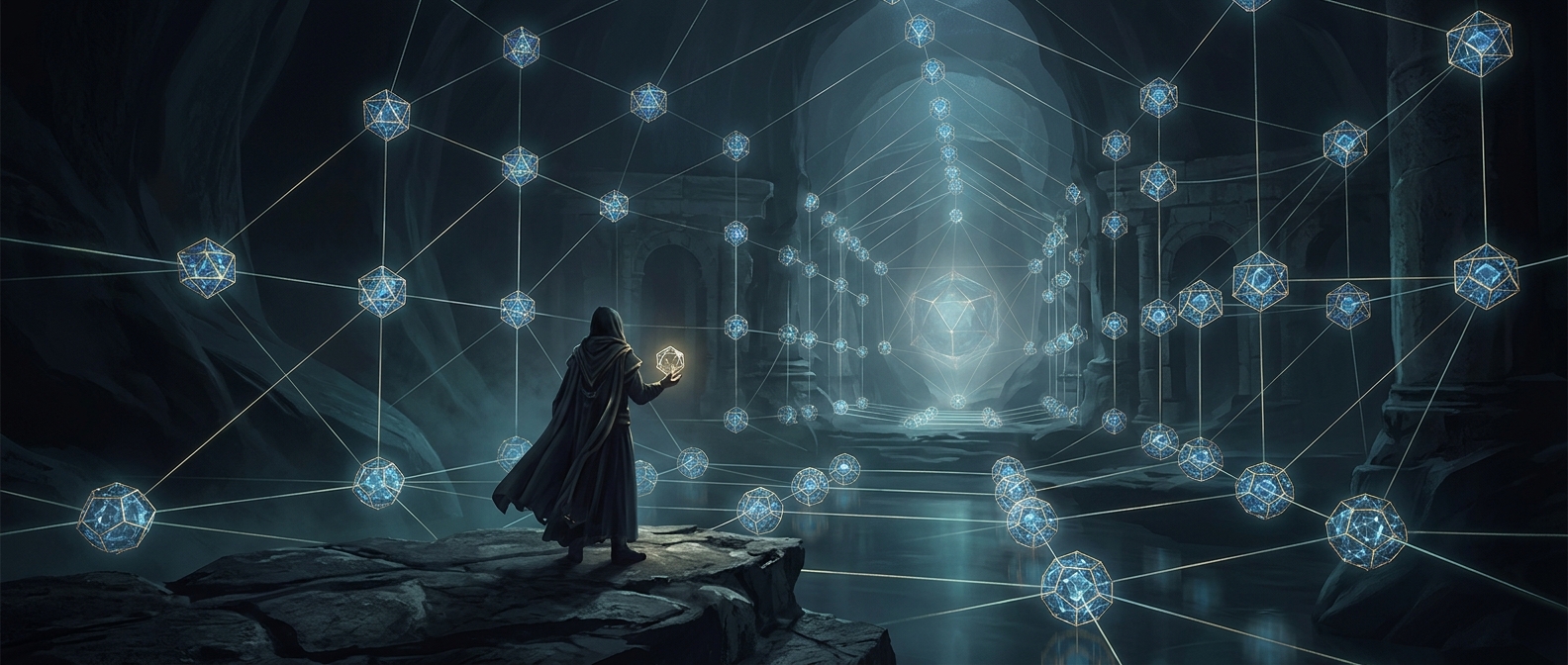
A shape built from repeating relationships
A regular dodecahedron is made from twelve identical pentagons, with the same arrangement meeting at every corner. Its order comes not from a single central line or flat grid, but from relationships repeated across the whole solid: each face connects to neighboring faces, and no one face appears to govern the rest. That makes the shape a useful image for a world understood as interconnected and patterned.
The geometry also has a less obvious counterpart. If you place a point at the center of each pentagonal face and connect points on neighboring faces, the resulting solid is an icosahedron, a form built from twenty triangles. This pairing shows how one structure can be described through two complementary patterns—pentagons and triangles—without changing the underlying symmetry.
From geometry to a model of order
In esoteric interpretations, the dodecahedron can therefore stand for more than an unusual object. Its regularity offers a way to imagine hidden order: visible forms may differ, yet share a deeper pattern of connections. The “grid” in this sense is conceptual, not a literal network drawn inside space. The solid gives an abstract idea a shape that can be pictured and handled.
That distinction is part of the symbol’s appeal. A dodecahedron does not point to one privileged direction or face; its balanced structure invites the thought that order can emerge from relations among parts. It turns an invisible principle into a compact geometric image—twelve distinct surfaces held together by one consistent arrangement.