Your speed has two parts
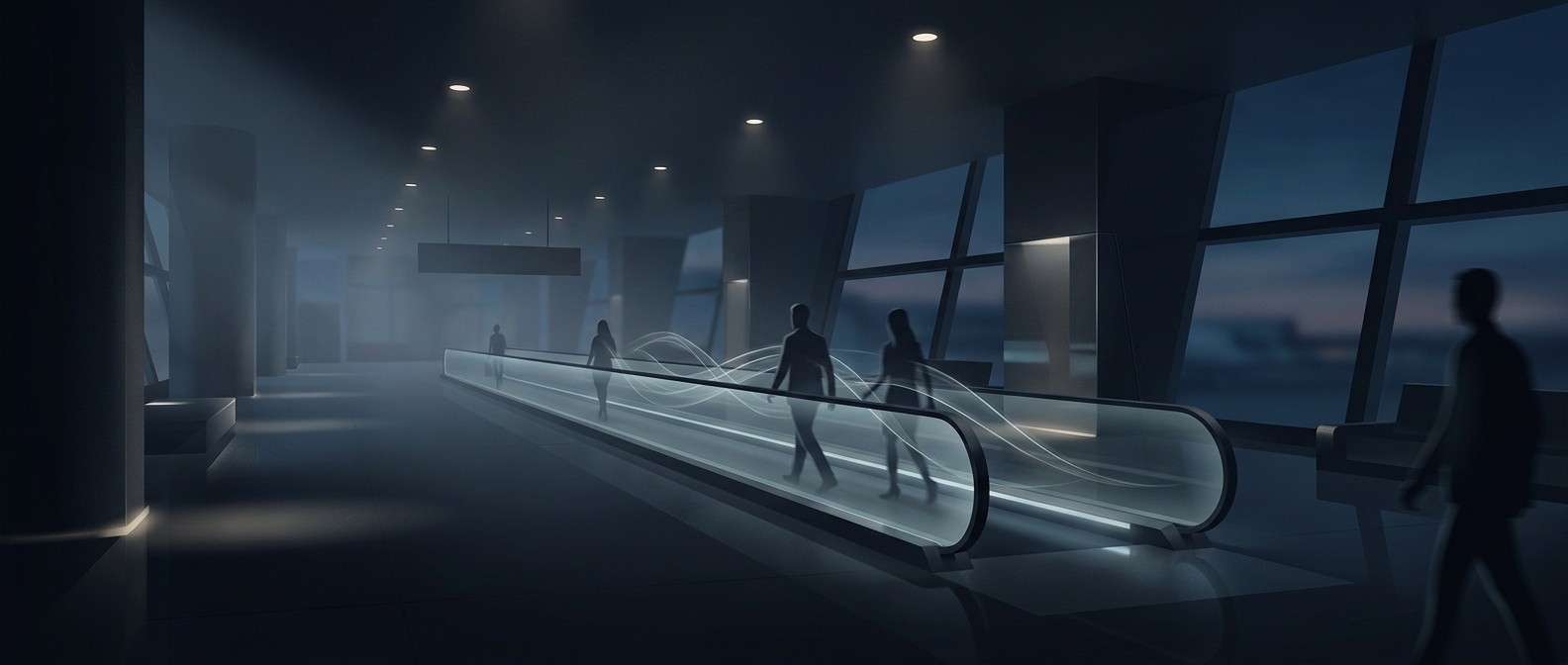
A moving walkway carries you forward while your legs carry you forward relative to its surface. If you keep the same stride and cadence—the rhythm of your steps—those two motions add together. But many travelers unconsciously shorten their stride or step less briskly once the belt is moving, reducing the extra speed their own walking contributes.
The result is a small mismatch between what the walkway seems to promise and how quickly you actually cover the terminal. The belt is still doing useful work: even standing still, you are being transported. But the gain from walking on top of it depends on how much of your ordinary walking pace you maintain.
Why your pace changes
A walkway is a moving reference point beneath your feet. As you step aboard, your balance system and vision register that motion, and your body adjusts its movements to keep walking comfortably. The surrounding floor and other travelers also provide visual cues about how fast you are going. When the belt supplies part of the forward motion, there is less reason—or sometimes less comfort—in taking the same long, quick steps you would on stationary ground.
That adjustment can happen without a deliberate decision. The belt may feel like a boost, while your legs quietly contribute less. Walking briskly can still add speed, but the boost is not automatic: it depends on continuing to walk at a similar pace relative to the belt.
A tradeoff built into the shortcut
For airports and other long indoor routes, moving walkways reduce the effort of covering distance, especially for people carrying bags or walking slowly. They are not necessarily a way to make every traveler dramatically faster. The clearest benefit comes when the walkway keeps you moving while you rest; any extra time saved by walking depends on how fully you keep up your stride.